Auvrenth Health Monitor
Auvrenth Health Monitor
Description
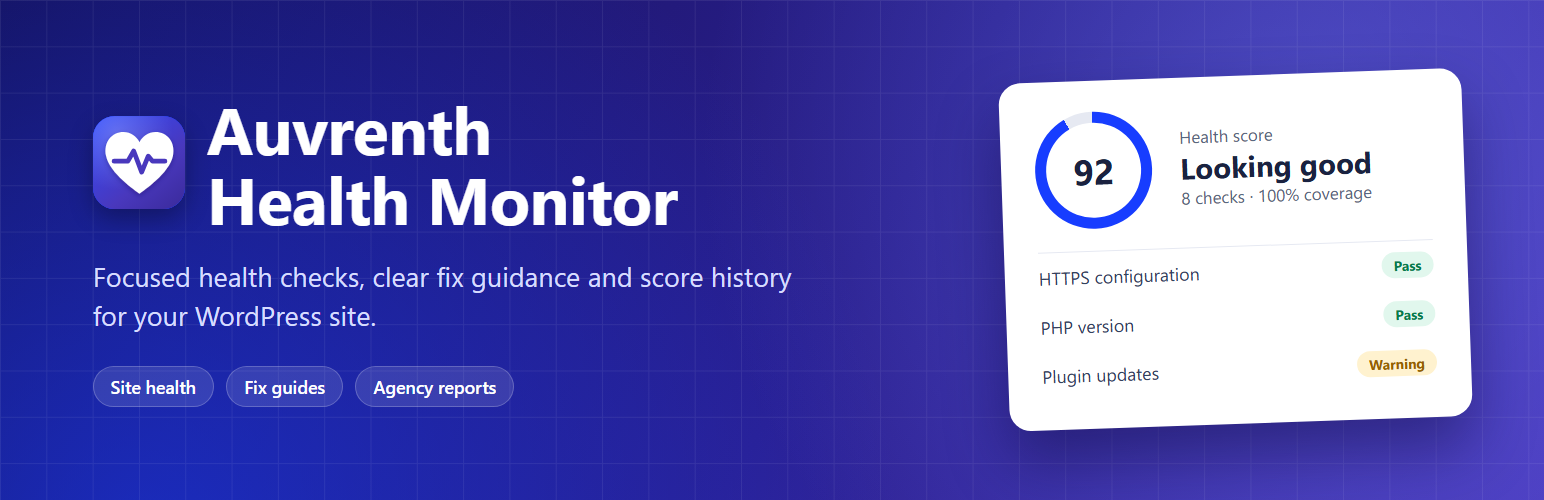
Auvrenth Health Monitor turns WordPress maintenance into a short, clear to-do list.
Run a scan and get a health score, the issues that need attention, why each one matters and a safe next step, with a link to the official WordPress documentation. No account and no external dashboard. Scan data stays in your own WordPress database.
The plugin only reads site state. It never updates software, changes settings or “fixes” things behind your back, so you stay in control of every change.
Why site owners and agencies use it
- One clear score. A weighted 0-100 health score, shown together with check coverage so you always know how much of the site could be assessed.
- Fix guides, not just warnings. Every finding explains what was found, why it matters, the evidence behind it and a safe next step.
- History you can show. Track scores over time, export CSV and print client-ready reports.
- Agency ready. Manage the health of many client sites from one dashboard, without a third-party monitoring service.
16 focused health checks
Each check is read-only, time-bounded and weighted by how much it matters:
- HTTPS configuration – confirms both WordPress URLs use HTTPS.
- WordPress core updates – reports available core releases.
- Plugin updates – counts plugins with available updates.
- Theme updates – counts themes with available updates.
- PHP version – compares your PHP version with WordPress’s recommendation, using WordPress Site Health data.
- Public error display – detects PHP errors that could be shown to visitors.
- REST API loopback – checks that the site can reach its own REST API, which many features rely on.
- Scheduled tasks – confirms the plugin’s scheduled scan is registered and not overdue.
- Overdue scheduled events – flags a backlog of WP-Cron events that should already have run.
- Dashboard file editing – warns when administrators can edit plugin and theme files from the dashboard.
- Default administrator username – detects an administrator account named “admin”.
- Automatic security releases – confirms automatic WordPress security updates are not disabled.
- Autoloaded options size – warns when autoloaded options exceed the 800 KB WordPress recommends.
- Inactive plugins – counts installed plugins that are not in use.
- PHP resource limits – checks PHP memory and execution-time limits.
- Persistent object cache – recommends a persistent object cache on larger sites.
A check that cannot run is marked as skipped. It lowers coverage instead of unfairly lowering the score. A score summarizes the completed checks; it is not a security certification.
Overview dashboard
- Health score, check coverage, open issue count and last scan time at a glance.
- Per-check results with Pass, Warning, Fail or Skipped status and the evidence behind each result.
- Run a scan on demand with one click.
Issues & Fix Guides
- Only findings supported by the most recent completed scan are shown.
- For each issue: what was found, why it matters, a safe next step, the evidence and a link to the official documentation.
- Issues are tracked over time, so a resolved issue closes automatically and a returning issue is flagged again.
History & Performance
- Score trend chart from oldest to newest scan.
- Table of recent scans with score, coverage, scan time and PHP peak memory.
- Scans run manually or daily through WP-Cron, with automatic retries if a scheduled scan fails.
- Keep history for 7 to 90 days. Older data is pruned automatically.
Reports
- Download score and coverage history as CSV for any date range.
- Open a printable report with the latest score, items to review, next steps and the recent trend, then print it or save it as PDF from your browser.
- Reports are available for this site and for every paired client site.
Email alerts
- Optional email alerts for new or returning failed checks.
- Alerts use a cooldown so the same problem does not flood your inbox.
- Emails are sent through your site’s own WordPress mail setup.
Agency Manager (optional, off by default)
Turn one WordPress site into a central dashboard for your client sites:
- Secure pairing: connect a client site with a one-time code that expires after 10 minutes.
- Signed reports: client sites running the separate Health Monitor Connector plugin send small, signed health summaries over HTTPS. Replayed, unsigned or malformed reports are rejected.
- Client overview: see each site’s latest score, coverage, last report time and reported issues.
- Search, filter and group: find sites by name, URL or group, and filter by low score (below 70), stale (no report for 48 hours), awaiting first report, active or revoked.
- Internal notes: record follow-up notes per site. Notes stay on the Manager and are never sent to the client.
- Key rotation and revocation: rotate a site’s connection key or revoke it at any time.
- Agency alerts: optional emails when a client’s score drops below 70, recovers, reports a failing check or stops reporting for 48 hours.
The Manager validates each client report and stores its score and issue statuses. It does not log in to or scan client sites directly.
Built-in support
- Select the Ask a question button on any Health Monitor screen to send a question to the team without leaving WordPress.
- Choose a topic, write your question and optionally include basic site details so the team can help faster.
- The reply arrives in your email inbox.
Built for developers
- REST API under
wphm/v1for the dashboard, checks, issues, history and agency sites, restricted to administrators. - Filters to add scan schedules (
wphm_scan_schedules), extend history retention (wphm_max_retention_days) and white-label printed reports (wphm_report_brand). - Multisite aware activation and deactivation.
- Fully translatable.
Pro add-on
Auvrenth Health Monitor is fully usable on its own. A separately distributed Pro add-on adds more frequent scans, extended history, weekly summaries and external uptime checks.
Privacy and data
Local scans store check outcomes, small evidence values, scores, coverage, timestamps and scan metrics in the site’s WordPress database. The PHP version check uses WordPress’s Site Health information, which may contact WordPress.org’s Serve Happy API. The REST API check requests the site’s own REST endpoint.
When an administrator enables Agency Manager and pairs a client, that client sends its site name and URL during pairing. Later Connector reports send a score, coverage, approved check IDs and statuses, and the Connector version to the administrator-selected Manager site. The Manager stores the client name and URL, report history, issue statuses, connection credentials and any internal notes entered by its administrators. Reports do not include passwords, posts, user lists or customer records. The plugin does not use a developer-operated monitoring service.
Support questions
The Ask a question form sends data only when an administrator submits it. It sends the name, reply email address, topic and question to https://wp-taxonomy-manager.com/wp-json/wtmp-support/v1/message, which emails them to the support team. If Include site details stays checked, it also sends the site address, plugin version, plan (free or Pro), WordPress and PHP versions and site language. Privacy policy.
Email alerts and data removal
Email alerts are optional and are sent through the site’s WordPress mail setup. History retention is configurable, and deleting the plugin through WordPress removes its stored data. Revoking a client in Agency Sites stops future reports. Disconnecting only on the client does not remove the Manager’s existing records.
Installation
- Go to Plugins Add New, search for “Auvrenth Health Monitor”, then install and activate it.
- Open Health Monitor in the WordPress admin menu and select Run health scan.
- Review Issues & Fix Guides and follow the suggested next steps.
- Optional: in the Settings tab, choose a daily or manual scan schedule and how long to keep history.
Setting up agency monitoring
- On your public HTTPS agency site, open Health Monitor Agency & Reports Manager settings and enable Agency Manager.
- Install the separate Health Monitor Connector plugin on each public HTTPS client site. The Connector is not yet available on WordPress.org, so email contact.rakib@wp-taxonomy-manager.com to receive the Connector ZIP.
- In Agency Sites, select Generate pairing code.
- On the client site, open Settings Health Connector and enter the pairing code and the Manager URL.
Agency pairing requires OpenSSL and publicly reachable HTTPS sites. Scheduled scans depend on WP-Cron or a server cron. Email delivery depends on the site’s mail configuration.
Screenshots

Overview with health score, check coverage, open issues and per-check results.

Issues & Fix Guides explain why each finding matters and the safe next step.

History & Performance shows the score trend, scan time and PHP peak memory.

Reports let you download CSV history or open a printable client report.
Faq
No. The score covers only the checks that completed. Read it together with coverage and the individual findings.
No. It shows suggested next steps and documentation so an administrator can decide what to change. The plugin never changes your settings or updates software.
No. Checks only run when you start a scan or when the scheduled scan runs in the background. Each scan has a time limit, and nothing runs on visitor page loads.
No. Everything runs inside your WordPress site and is stored in your own database. Agency monitoring connects your own sites directly to each other.
No. Local checks, history, reports, email alerts and Agency Manager all work in this plugin. The Connector is only needed on client sites that send reports to an Agency Manager. Pro is optional.
Only users who can manage site options, which are administrators by default. The REST API uses the same restriction.
Not directly. A WordPress site cannot independently confirm another site’s outage. A missing report after 48 hours is a signal to investigate, not proof that the client site is down.
Deleting the plugin through Plugins Installed Plugins removes its tables, settings and scheduled events.
Reviews
Changelog
1.1.0
- Add eight read-only checks: dashboard file editing, default administrator username, autoloaded options size, inactive plugins, automatic security releases, PHP resource limits, persistent object cache and overdue scheduled events.
- Score policy 2: the new checks count one point each, so scores can change after updating. Earlier snapshots keep policy 1.
- Fix: CSV report columns now line up with their headings (date, score, coverage, score policy).
- Agency Sites explains how to get the Connector while it is not yet available on WordPress.org.
- History & Performance is paginated, 10 scans per page, so the trend chart and table stay readable on sites with long history.
- Refreshed admin design: score ring, colour-coded check results and issues, tab icons, and updated buttons, forms, tables and printable reports.
1.0.0
- Initial public release.
- Eight read-only health checks with a weighted score and check coverage.
- Issues & Fix Guides with evidence, next steps and documentation links.
- Score history, scan metrics, CSV export and printable reports.
- Optional email alerts with cooldowns.
- Optional Agency Manager with secure pairing, signed client reports, groups, filters, notes, key rotation, revocation and agency alerts.