Calucon Third-Party Embed Gate

Calucon Third-Party Embed Gate
Description
Every YouTube video, Google Map and Instagram post on your site contacts its provider the moment the page opens — before the visitor has agreed to anything. Calucon Third-Party Embed Gate holds those embeds behind a click-to-load placeholder. Until the visitor presses “Load”, nothing is requested from the provider and nothing is stored on their device — not by the provider, and not by this plugin. That is the two-click solution (Zwei-Klick-Lösung), done properly: no cookie banner, no consent platform, no account, no subscription. It works the moment it is activated.
See it on the live demo — all 36 providers on one page, 30 of them with live content, and zero third-party requests until you press a button — or read the details on the plugin page.
Why it matters
A plain request to www.youtube.com/embed/… — no playback, no scripts run — sets six cookies, four of them identifiers that live about six months (measured August 2026). Every visitor gets them on every page with a video, whether or not they ever press play. The same request to www.youtube-nocookie.com sets none, and that is where this plugin loads YouTube from after the click.
How it works
- You keep writing posts as before: paste a URL, WordPress makes the embed, and editors see the normal embed in the block editor.
- Visitors see a placeholder instead — rendered on the server, so it is there before any JavaScript runs: the provider’s name and icon, one sentence on what loading means, a real “Load” button, and a plain link to the content for anyone who prefers to open it there.
- On the click, that one embed loads — from the privacy-preserving address where the provider has one. Nothing else on the page changes, and nothing loads for embeds the visitor did not ask for.
What you get
- Works on activation, with no configuration, no account and no external service.
- Names 36 embed types — every one WordPress offers out of the box, from YouTube and Vimeo to Spotify, Google Maps, X, Instagram, TikTok and Calendly — with an icon, a notice, an optional privacy-policy link and a working no-JavaScript link. Anything it does not know is gated all the same: the plugin gates by host, not by a list, so a new tracker is never let through by accident.
- Finds the embeds your caching and optimisation plugins have already minified — attribute quotes stripped, newlines inside tags — which is where most implementations silently fail. Also lazy-loaded markup (
data-src), the loader scripts and stylesheets some embeds bring along, and content delivered over AJAX and the REST API (“load more”, infinite scroll). - Accessible and JavaScript-free by design: a named group, a real button, visible focus, sufficient contrast, focus kept after loading; zero axe-core violations in CI. Without JavaScript the link still works.
- Loads from privacy-preserving endpoints where they exist:
youtube-nocookie.com, Vimeo withdnt=1. Rebuilds every embed from an attribute safelist —sandboxpreserved,autoplaynever survives — and strips thepreconnectanddns-prefetchhints that would contact the provider early. - Looks like your site, without CSS: quick styles, colours that follow your theme’s palette, corners, borders, shadows, button styles and dark-mode colours, with a live preview and an automatic readability check — plus a poster image per embed from your own media library, never fetched from the provider, and per-embed button and notice text in the block editor.
- Speaks German: the plugin ships translated for all five German locales (Germany du and Sie, Austria, Switzerland), and the texts you type are registered for WPML and Polylang.
- Optional and off by default: remember the visitor’s choice in their browser (per embed, per provider or for all; for the session or a number of days) with a withdrawal block and shortcode — and a bridge to your consent platform, so a consent given there loads the embeds and a withdrawal there re-gates them.
- Never phones home. No telemetry, no update check against a private server, no remote font or script — no outbound request from your server or your visitors’ browsers, on any path, for any reason.
Works with
- Caching and optimisation plugins: W3 Total Cache, WP Super Cache, LiteSpeed Cache, Autoptimize, WP Fastest Cache, SiteGround Optimizer, WP Rocket. Gating happens on the server, so the cached page is the gated one; Status & tools names the files to exclude from “delay JavaScript” and where that plugin keeps its list.
- Consent platforms, through the optional bridge: WP Consent API, Complianz, Cookiebot, CookieYes, Borlabs Cookie 3, Real Cookie Banner. The bridge only reads the platform’s answer; with any other platform, or no answer, gating stands.
- Page builders: Elementor’s HTML and video widgets are gated out of the box. For a builder that renders outside WordPress’s content filters, “Gate the whole page output” under Detection reads the finished page instead.
- Multilingual sites: WPML, Polylang, TranslatePress, Weglot.
Every month those claims are re-tested on a real WordPress against the current versions of the plugins that are free to install; the ones that are not (WP Rocket, Borlabs Cookie, WPML, Weglot, Cookiebot’s banner) are tested against simulations of their documented behaviour.
What it is not
Calucon Third-Party Embed Gate is a technical measure, not a consent management platform. It prevents the embed providers’ requests until the visitor acts, and the click is consent for that one embed (or, with consent memory on, for the scope you configure). It does not produce consent records for accountability purposes, it does not audit your site for other trackers, and it makes no legal claim about your site. Your privacy policy still has to name the providers you embed from, and your legal bases remain yours. If you need a documented consent record, you need a consent management platform.
For developers
- Theme override: copy
templates/placeholder.phpto{your-theme}/calucon-embed-gate/placeholder.php. - CSS custom properties on
.cg-embed(--cg-bg,--cg-fg,--cg-accent, …) for restyling without specificity wars. - WP-CLI:
wp calucon-embed-gate scan(is every embed gated?--format=jsonfor CI and automation) andwp calucon-embed-gate providers. Both read-only. - Documented filters:
calucon_embed_gate_providers,calucon_embed_gate_provider_for_url,calucon_embed_gate_should_gate,calucon_embed_gate_is_own_host,calucon_embed_gate_own_hosts,calucon_embed_gate_placeholder_html,calucon_embed_gate_payload,calucon_embed_gate_note_text,calucon_embed_gate_action_text,calucon_embed_gate_fallback_url,calucon_embed_gate_www_equivalence,calucon_embed_gate_cmp_config,calucon_embed_gate_asset_version,calucon_embed_gate_the_content_priority,calucon_embed_gate_render_block_priority, plus thecalucon_embed_gate_before_render,calucon_embed_gate_embed_gatedandcalucon_embed_gate_flush_cachesactions. Each one’s signature, when it fires and what to return are documented indocs/customizing.md, which ships inside the plugin (wp-content/plugins/calucon-third-party-embed-gate/docs/customizing.md) and is readable on GitHub. Adding a provider is a ten-line filter infunctions.php. - Stable since 1.0: the markup contract (
cg-classes,data-cg-*attributes,--cg-*custom properties), the documented hooks, the template variables, the settings keys and the WP-CLI commands do not change across minor releases; provider descriptors and the tested-platform lists are data and may.docs/customizing.mdships inside the plugin and is written for developers and AI coding agents alike.
External services
This plugin makes no request to any external service, on any page, at any time. It contacts no API, loads no remote script, font, image or update check, and sends no telemetry. Its entire purpose is the opposite direction: it prevents your pages from contacting embed providers.
Third-party content enters the picture only after a visitor clicks the “Load” button on an embed placeholder. At that moment the visitor’s browser loads that one embed from its provider (for example YouTube, Vimeo or Google Maps) — exactly as it would have without this plugin, except that it now happens on the visitor’s request instead of automatically. Each placeholder names the provider and, when the optional link is turned on under Providers, links the provider’s privacy policy before the click. The provider hostnames in the plugin’s source code exist solely so it can recognise and gate that content. No data is sent anywhere by the plugin itself.
Installation
- In your WordPress admin, go to Plugins Add New, search for “Calucon Third-Party Embed Gate”, click Install Now, then Activate. To install from a downloaded zip instead, go to Plugins Add New Upload Plugin.
- That is all. Third-party embeds on the front end are now click-to-load, and nothing third-party is contacted before the visitor clicks. Editors keep seeing the normal embed in the block editor, so nothing changes about how you write posts.
- Optional: open Settings Calucon Third-Party Embed Gate to adjust appearance, per-provider behaviour, detection rules, consent memory and the consent-platform bridge. None of it is needed to be protected.
If you turn on consent memory, give visitors a way back: add the “Withdraw embed consents” block, or the [calucon_embed_gate_withdraw] shortcode, to your privacy-policy page.
Requirements: WordPress 5.9 or newer and PHP 7.4 or newer. No build step, no runtime dependencies, and no outbound request from your site on any path.
Screenshots
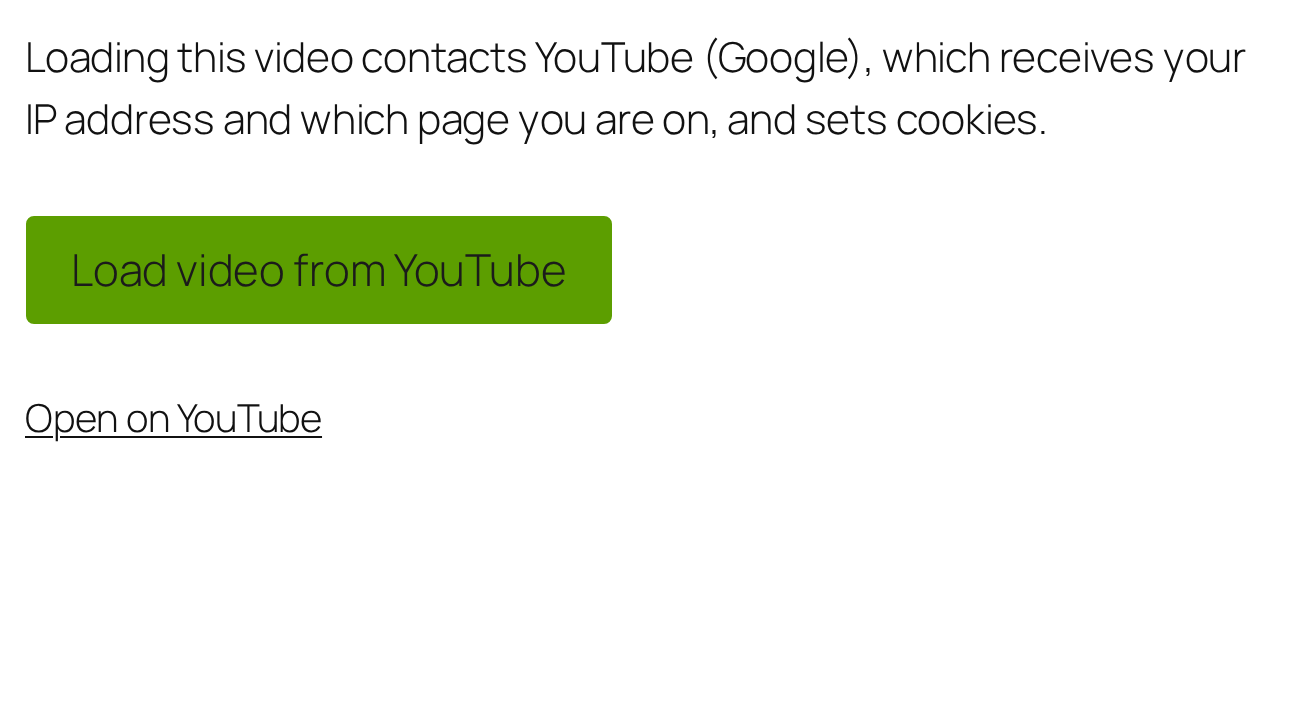
A gated YouTube embed as a visitor sees it: a server-rendered placeholder with a named panel, a real "Load" button and a working fallback link — nothing is requested from the provider until the click.

The Appearance settings: quick styles, colours that follow your theme's palette, sections for shape, button, poster image, withdraw button and dark mode, a live preview of the real panel and an automatic readability check.

The content scan on Status & tools: every embed found in your recent posts and pages, the address it would contact, whether it is gated, and one click to name an unknown host or let it through.

The Providers tab: providers grouped by what the embed is, with a filter box — per-provider on/off, privacy-preserving load variants, custom notice and button text, the privacy-policy link and your own providers.

The per-embed control in the block editor: gate this embed always, never or per the site default, set a poster image from your own media library, and give it its own button and notice text.

The Content-Security-Policy helper: a check of your own site for a policy, the exact lines to add for the providers you have enabled, and which provider needs which host.
Faq
No plugin can claim that, and this one does not. Calucon Third-Party Embed Gate implements a technical measure: it prevents third-party embed requests, and the storage they trigger on the visitor’s device, until the visitor explicitly asks for the content. Whether your site’s processing as a whole is lawful depends on things a plugin cannot know. The background — § 25 TDDDG / ePrivacy Art. 5(3) for storage on the visitor’s device, GDPR Art. 6(1)(a) for the processing after the click — is described in the documentation, and your privacy policy still has to name the providers you use.
Because there is nothing to announce at page load. If nothing third-party loads until the visitor asks for it, there is no third-party storage to consent to on page load. The consent is the click, given for the one embed it belongs to.
No. Out of the box the plugin ignores the banner and keeps gating: visitors see your banner for its categories and the placeholder for embeds, and nothing double-blocks, because the placeholder contains no iframe or script for a banner’s blocker to catch. If you prefer one decision instead of two, enable the consent-platform bridge under Settings Calucon Third-Party Embed Gate Consent memory: a consent given in the platform then loads the embeds, and a withdrawal there re-gates them. The bridge works with the platforms listed on that screen; with any other it stays out of the way. If you would rather have your platform’s own blocker handle a specific provider, disable that provider under Providers and the plugin steps aside for it.
By default, yes: once per embed, on every page, and nothing is stored on the visitor’s device to remember it. If that is more friction than you want, Consent memory can remember the choice in the visitor’s browser — for that one embed, for everything from that provider, or for all embeds — until the browser is closed or for a number of days you choose. It is off by default and stores nothing before the visitor’s first click. When you turn it on, give visitors a way back: the “Withdraw embed consents” block or the [calucon_embed_gate_withdraw] shortcode clears what was remembered.
Yes. Gating happens on the server, so the page that gets cached is the gated one, and minified HTML is expected rather than a problem — the scanner is built for it. Deferring, combining or lazily injecting the plugin’s script all work too.
One setting is worth knowing about: “delay JavaScript until interaction” holds every script back until the visitor first interacts, and that interaction is spent switching the scripts on — so the first click on a “Load” button does nothing and they have to click again. Nothing third-party is contacted by the extra click, but the placeholder feels broken. Settings Status & tools lists the exact files to paste into your optimisation plugin’s exclusion list, and reports what it could read about that plugin’s JavaScript settings.
If your assets are served from a CDN hostname, that is recognised as your own: most CDN plugins filter the WordPress functions that say where your files live. A CDN that rewrites the finished page instead is invisible to that, so scripts and stylesheets on a /wp-content/ or /wp-includes/ path are left alone whatever host serves them — which does not cover images, one reason third-party image gating is off by default.
And if the placeholder looks unstyled after an update: a minification setup that serves CSS from a long-cached URL can keep browsers on the old stylesheet. A hard reload fixes it; the plugin cannot.
Elementor’s HTML and video widgets are gated out of the box. Other builders render outside WordPress’s content filters, where the plugin listens by default: enable “Gate the whole page output” under Settings Calucon Third-Party Embed Gate Detection and the plugin reads the finished page instead. It is off by default because whole-page buffering can conflict with other buffering plugins.
Open Settings Calucon Third-Party Embed Gate Providers and press “Check what is on my site”. The scan lists every embed in your recent posts and pages with the address it would contact. Next to each one you can either name it — which keeps the gate on but gives the placeholder a proper label and icon — or let it through, which means it loads for every visitor with no placeholder. You never have to work out a host name yourself, and nothing changes until you press Save. Hosts you have let through stay listed at the top of the same screen with a one-click undo.
Videos: YouTube, Vimeo, Dailymotion, TED, VideoPress and WordPress.tv, TikTok. Audio: Spotify, SoundCloud, Apple Music, Mixcloud, Pocket Casts. Maps: Google Maps, OpenStreetMap. Social posts: X, Instagram, Facebook, Reddit, Tumblr, Bluesky, Pinterest, Imgur, GIPHY, Strava. Documents: Scribd, Speaker Deck, Issuu, Wolfram Cloud, Amazon Kindle, Kickstarter. Forms and calendars: Google Calendar, Google Forms, Typeform, Calendly, Crowdsignal. 3D: Matterport, Sketchfab.
Everything else is gated too — that does not depend on a list. An embed from an unnamed host gets the same placeholder and the same button, named after the host it would contact, with a link to the content itself. What a named provider adds is the label, the icon, the privacy-policy link and a tidier “Open on …” link. A few of core’s own embed blocks are not named yet (Flickr, SmugMug, Animoto, ReverbNation, Cloudup); you can name them yourself under Providers Your own providers.
Some embeds bring a loader script or stylesheets along with the player (VideoPress, Scribd, Wolfram Cloud). Those are gated together with the embed they belong to and load on the same click, not before it.
Yes, without code: Providers Your own providers takes a name, the embed hosts (one per line) and, optionally, script hosts and a kind for the button icon. After saving it appears in the provider table with its own notice, button text and privacy-policy link. Unknown hosts are gated either way — a provider of your own only gives such a host a proper name and texts. Hosts the built-in providers handle stay with them, and your own providers are always gated; the never-gate list under Detection is the place to exempt a host.
Yes. The Appearance tab has quick styles, colours that can follow your theme’s palette, and controls for corners, border, shadow, spacing, the button, the poster image and dark mode, with a live preview and an automatic readability check. One checkbox on the Providers tab adds a link to each provider’s own privacy policy to the placeholder (off by default; the URL can differ per provider, and showing the link fetches nothing). Your own CSS still works on top: the panel exposes CSS custom properties and a template override (see docs/customizing.md in the plugin folder).
Yes. German ships with the plugin for all five German locales WordPress offers — Deutschland informal and formal (“de_DE”, “de_DE_formal”), Österreich (“de_AT”), and Schweiz formal and informal (“de_CH”, “de_CH_informal”, spelled with ss instead of ß) — and it covers everything a person reads: the placeholder your visitors see, the settings screen and the block-editor controls. Set your site language and it follows. Other languages are welcome via translate.wordpress.org; a translation from there overrides the bundled one.
Consent Mode is deliberately not read or written. It is a signal that consent platforms send to Google’s tags; Google publishes no API for other scripts to read it, and no Consent Mode signal governs iframes such as YouTube embeds. The bridge instead connects to the consent platform itself — the same place Consent Mode gets its state from — which is the reliable way to honour the same visitor choice. The plugin also never sends gtag('consent', …) updates: a click on one embed is consent for that embed, not a site-wide marketing consent, and misreporting that would be wrong.
No. Lazy loading defers the request to scroll time — it is still made without consent. Lazy iframes are gated like any other.
Either is gated, so this is not a privacy question. It is a rendering one: prefer the plain <iframe> embed code where the provider offers one. An iframe renders by itself; a loader script has to notice the embed and draw it, and some providers’ scripts only do that while the page is first parsing, so they can come up empty after the visitor clicks — with or without this plugin. If a script-based embed stays blank after loading, try the provider’s iframe embed code instead.
Only if your site sends a Content-Security-Policy header — most WordPress sites do not. The section on Status & tools can check your own home page for one (from your browser, nothing leaves your site) and tells you whether the enabled providers are already allowed; if not, it lists the lines to add.
Privately, please — through GitHub’s private vulnerability reporting on the plugin repository (https://github.com/Calucon/calucon-third-party-embed-gate/security/advisories/new), not in a public issue or support topic. The repository’s SECURITY.md describes what counts: besides the usual classes, any way to make a page contact a third party before the click is a vulnerability.
Reviews
Changelog
1.0.0
- Security: the placeholder’s payload — what the front-end script loads after the click — moves from a
data-cg-payloadattribute into a<script type="application/json" class="cg-embed__payload">element inside the panel, and the script reads it from nowhere else. WordPress lets users without theunfiltered_htmlcapability (Contributors, Authors) writeclassanddata-*attributes on any tag, so the attribute form was forgeable in post content and could execute script in a visitor’s browser after a click; a<script>element is exactly what WordPress never lets them write. If you override the template, echo$payload_tag(which replaces$payload_attr) as a direct child of the container. Inert script blocks (JSON-LD, templates) are also no longer treated as loaders. - Security: a
?context=editquery string switched gating off for whoever sent it — any visitor following such a link was served the raw embeds. The parameter marks an editing context and is now honoured only for users who can edit posts, like the AJAX and REST editor paths already were. - Security: the fallback and privacy links and the poster URL are now scheme-checked the way a browser reads a URL — tab, newline and leading control characters stripped first — so a
java<TAB>script:URL arriving from a page-builder setting or a filter can no longer land in a link. Elementor’s video widget also no longer links to itsyoutube_urlsetting unless that setting is a real page. - Fixed: the two on-demand scans on Status & tools (recent content, theme files) require the page’s own nonce; a bare query string no longer makes an administrator’s browser run them.
- Fixed: an Elementor video setting containing a backslash came out of the gate’s rewrite as invalid JSON, so Elementor could not read its own remaining settings.
- Security: the HTML scanner reads markup the way a browser does — a tag opens only where a browser opens one. Before, a comment opener or a raw-text tag name inside an attribute value (
<div data-x="<!--">) hid every embed after it from the gate, silently, and an<iframeinside analttext got a placeholder spliced into the attribute; both are within reach of any author, since WordPress keeps<inside attribute values. - Changed: the wordpress.org listing text was rewritten to say first what the plugin is and why; no functional change.
- Removed: the experimental IAB TCF v2.2 bridge and its setting. It could not be validated against any real TCF platform (none is free to test), and 1.0 promises only what is proven. Sites that had the flag on lose nothing that worked: the platform bridge itself is unchanged.
- 1.0: the plugin is feature-complete and enters maintenance. From here on the markup contract (the
cg-classes — including thecg-embed__payloadJSON script element that replaces the 0.xdata-cg-payloadattribute — thedata-cg-*attributes and--cg-*custom properties), the documented filters and actions, the template variables, the settings keys and the WP-CLI commands are stable across minor releases; provider descriptors and the tested-platform lists are data and may change in minors. New features are not planned; fixes, field-validation findings and WordPress/PHP compatibility are. - Fixed: Elementor’s video widget was not gated at all — Elementor builds the YouTube player from a JSON attribute in its own script, so there was no iframe to find, and the page contacted YouTube and DoubleClick before any click. The widget now gets the same placeholder as any other embed, with the owner’s overlay image as its poster; Vimeo and Dailymotion widgets render a real iframe and were already gated. Found by the new field-validation suite, which runs the compatibility claims against the real plugins (see the repository’s docs/field-validation.md).
- Fixed: with a CDN serving your assets from another hostname and whole-page gating enabled, the plugin could treat your site’s own scripts and stylesheets as third-party and replace them with a placeholder — which broke the page’s JavaScript instead of protecting anyone. The site’s own asset hosts (from
content_url(),includes_url(),plugins_url(), the uploads base and the theme URIs) now count as its own, so a CDN plugin that filters those is trusted automatically. For a CDN that rewrites the finished page instead, a/wp-content/or/wp-includes/path is left alone whatever host serves it — scripts and stylesheets only, never iframes, and your always-gate list still overrides it. - New: Status & tools lists the plugin’s own asset paths to paste into a caching or minification plugin’s exclusion list, and reports what it could read about the JavaScript settings of the caching plugin you have installed — including, honestly, when it could read nothing.
- New: Status & tools now also names WHERE that exclusion list lives in the plugin it detected — Performance Minify JS for W3 Total Cache, File Optimization for WP Rocket (which keeps a separate box for “Delay JavaScript execution”), and so on for LiteSpeed, Autoptimize, WP Fastest Cache and SiteGround Optimizer. Two answer honestly rather than invent a path: Cloudflare’s Rocket Loader takes no list and is switched off per script, and WP Super Cache does not touch JavaScript at all.
- Fixed: a third-party script or stylesheet served from a
/wp-content/or/wp-includes/path is no longer exempt from gating when its host belongs to a provider the plugin already knows. The exemption exists for CDNs that rewrite the finished page, and a path is a heuristic about the shape of a URL — shape being something anyone can copy. The failure mode it removes is the invisible one: letting something through, rather than gating something harmless. - Fixed: the plugin could replace its own
gate.jswith a placeholder. Putting your asset CDN’s hostname on the always-gate list is enough — that list correctly overrides both the own-host rule and the path exemption, and the plugin’s own script is then served from a gated host. The result was silent and total: every placeholder became a button that did nothing, because the script that would have handled the click was the thing that got gated. - Fixed: the page cache is now flushed on the first save of the settings too. A site that had never opened the settings screen had no stored settings, so WordPress created them rather than updating them — a different event, which the plugin was not listening for. That first save is the one where gating usually gets turned on, so a page cache still holding pre-gate HTML was exactly the case the flush exists to prevent.
- Changed: the check for third-party asset hosts in your theme now runs when you ask for it, on the same button as the content scan, instead of on every load of the settings screen. It reads up to 40 of the theme’s stylesheets, which is the same kind of work the content scan has always been on-demand for.
- New: a FAQ entry on caching and minification plugins, a symptom cause fix table and the per-plugin exclusion-list locations in the shipped
docs/customizing.md. - Tests: gate.js is now exercised deferred, async, and injected after the load event has fired, plus the script order a combiner produces and the “delay JavaScript until interaction” setting. All of that already worked; none of it was covered. The own-host list — the half of the CDN fix that reads
content_url()and friends — is now covered too, together with whole-page gating, which is the pairing the fix exists for and which neither half had been tested with. The Compatibility screen’s consent-platform, page-builder and optimiser rows are exercised for the first time.
0.12.1
- Changed: the German translation was reviewed by the German translation team at translate.wordpress.org and corrected against their glossary and style guide. The Appearance tab is now called “Design”; “Reiter” became “Tab”, “Rahmen” became “Rand”, “Eigene” became “Individuell” where the English says “custom”, and a few sentences were rewritten because they read like English rather than German. Nothing changed for sites running in English.
- Internal: translations now go through a staged pipeline that verifies de_DE and de_DE_formal against the style guide and the glossary before deriving de_AT, de_CH and de_CH_informal — so a wrong word can no longer be copied into five locales at once.
0.12.0
- New: German translations ship with the plugin, for all five German locales WordPress offers — Deutschland (du und Sie), Österreich, and Schweiz (Sie und du, written with ss instead of ß as Switzerland does). WordPress does not fall back between them, so each one needs its own file. Everything a person reads is covered: the placeholder your visitors see, all five settings tabs and the per-block controls in the editor. Set the site language to German and it follows; a translation from translate.wordpress.org still takes precedence over the bundled one.
- Changed: the plugin loads its own translation files only on WordPress below 6.8, which is where it measured that WordPress stops finding bundled files by itself. Newer sites run without that call, as the plugin directory prefers. Nothing changes for sites running in English.
- New: the Compatibility overview names a detected multilingual plugin (WPML, Polylang, TranslatePress, Weglot) and says where the texts you typed yourself are translated — for WPML and Polylang, the screen that holds them; the other two translate the finished page and need nothing.
- Fixed: on WordPress older than 6.8, the bundled German never reached the block editor’s own controls — the front end and the settings screen were translated, the editor was not.
wp_set_script_translations()was not being told where the plugin keeps its translation files, so WordPress looked only in the language-pack directory. - Fixed: on WPML and Polylang sites, the texts you type yourself — a provider’s notice, button label or privacy-policy URL, and your own providers’ names — showed in the site’s default language on every translation. They are now read in the language of the page being built. Translate them in WPML’s String Translation or Polylang’s Strings screen; the shipped wpml-config.xml already registers them.
0.11.0
- New: page caches are flushed automatically when the plugin is activated and after it updates, not only when settings are saved or the plugin is deactivated — so a cached page cannot keep serving pre-update markup.
- New: the Providers tab is grouped by what the embed is (video, audio, social, documents…) with a filter box, so a long list stays manageable — and it no longer scrolls sideways on a phone. Each provider’s wording and privacy-policy link sit behind a per-provider toggle.
- New: the content scan on Status & tools is now actionable. Every embed it finds can be named (so an unknown host gets a proper label and icon) or let through, without typing a host name anywhere — and hosts you have let through are listed with a one-click undo. Nothing changes until you press Save.
- Changed: the Dailymotion test fixture pointed at a re-uploaded television series; test fixtures now use placeholder ids unless the target is the provider’s own, an institution’s own, or ours.
- Fixed: the “Withdraw embed consents” control sat against the left edge of the page on block themes instead of lining up with the text around it.
- Fixed: the settings screen’s read-only tables (Compatibility, the content scan, the Content-Security-Policy host list) pushed the page sideways on a phone; they now scroll within their own box.
- Fixed: on narrow screens the placeholder could be taller than the space reserved for the embed, hiding the fallback and privacy links behind a scrollbar that was easy to miss. The panel now grows to fit.
- Fixed: an embed whose script reserves an empty box of its own (Calendly’s inline widget) left a tall blank gap above the placeholder; the gap is gone while gated and comes back when the embed loads. Calendly placeholders now link the booking page instead of the script host.
- Fixed: the settings screen could claim “unsaved changes” after merely switching tabs or opening a section. Only changing a value counts now.
- Fixed: Scribd embeds (an inline script that fetches Scribd’s loader), VideoPress embeds (a resize loader) and Wolfram Cloud notebooks (stylesheets and an inline call) requested their provider before the click; these companions are now gated with their panel and load only after it. Scripts of your own that merely mention a provider’s address are left alone.
- Fixed: a script of your own that merely names a provider’s address in a comment could be removed and replaced with a placeholder, so the script stopped running. A provider address now only counts where a script actually loads it.
- Fixed: a second embed from the same provider on one page lost its placeholder and its link, and loaded on the first embed’s click. Each embed is its own again.
- Fixed: a placeholder for a Scribd or Crowdsignal embed that came with no address to link to could show a broken “Open on …” link. It now links the provider’s site.
- Fixed: with consent memory or a consent platform enabled, a returning visitor could get an embed that stayed blank because its loader ran before the script it needs. Also, remembering consent “for this embed only” treated every script-built embed as the same one, so a click on one could load another provider’s embed on the next page view.
- Fixed: a placeholder inside a
<noscript>block (Crowdsignal polls) offered a button that could never work, since that markup is only shown when scripting is off. It shows the notice and the link instead. - Fixed: “Name this host” put a host found as a script into the embed-hosts field, where it matched nothing.
- Fixed: after running the content scan, the “Check what is on my site” button on the Providers tab did nothing — it now takes you back to the results.
- Fixed: the block editor’s script and stylesheet were the last ones not cache-busted per build, so a rebuilt same-version install could keep the previous editor script.
- New: built-in providers for the rest of WordPress core’s embed types — Dailymotion, TED, VideoPress and WordPress.tv, Mixcloud, Pocket Casts, Scribd, Speaker Deck, Issuu, Kickstarter, Wolfram Cloud and Amazon Kindle (players and documents), plus Imgur, Tumblr, Pinterest, Bluesky and Crowdsignal (script embeds, now with a real fallback link to the post instead of the script host). All of these were gated before under their host names; they now get a name, an icon, a privacy-policy link and a Providers-tab row.
0.10.0
- New: an optional privacy-policy link in each placeholder, pointing at the provider’s own policy page (for the built-in providers that declare one; unknown embeds have no known policy). Off by default — a checkbox on the Providers tab turns it on.
- New: fine-grained appearance controls without CSS — custom corner radius, border width and colour, shadow strength, panel spacing, button size, an optional bundled play glyph on the button, notice text size and panel alignment, all mirrored in the live preview.
- New: the “Withdraw embed consents” control is now styled to match the panels (same colours and corners) with filled, outline and text-link variants.
- New: optional dark-mode colours, applied only when the visitor prefers a dark colour scheme.
- New: the Appearance tab is organised into sections with a one-click “Reset appearance to defaults”.
- New: load-button style (filled or outline), full-width option and hover strength; panel placement over poster images (corner card, centred card, or bottom bar) with a poster preview in the settings.
- New: per-embed button and notice text in the block editor, next to the existing gate override and poster controls.
- New: quick styles — four one-click starting points (Dark cinema, Light minimal, Brand card, Soft pastel) that fill in every Appearance control for you to tweak.
- New: the button icon is now chosen by what the embed is — play for videos, a pin for maps, a note for audio, a generic symbol otherwise; poster dimming; a separate link colour; a phone-width preview toggle.
- New: multilingual sites — the custom notice and button texts (settings and per block) are registered for WPML and Polylang via a shipped wpml-config.xml.
- New: per-provider privacy policy URL override on the Providers tab, for a localised or moved policy page (https only).
- New: a “Settings” link next to the plugin on the Plugins screen, and a “Support development” link in its row details.
- New: your own providers — name any embed host on the Providers tab (with optional script hosts and a kind for the button icon); it then gets the same note, button text and privacy-policy link controls as the built-ins. No code needed — and nothing to break: unknown hosts are gated either way, hosts a built-in provider handles are refused with a notice, and your own providers are always gated.
- New: ten provider kinds for the button icon — video, map, audio/podcast, social post, form, calendar/booking, document, image/GIF, 3D/virtual tour, generic — each with its own glyph; the built-ins are classified accordingly (X, Instagram, Facebook, Reddit and Strava as social posts; Typeform and Google Forms as forms; Calendly and Google Calendar as calendars; Matterport and Sketchfab as 3D; GIPHY as image), and the Providers tab shows every provider’s icon.
- New: the Content-Security-Policy section (Status & tools) now explains in plain language whether you need it at all, can check your own home page from the browser for an existing policy and say which provider hosts it still lacks, offers a Copy button, and lists which provider needs which host. It is collapsed by default — most sites send no policy.
- New: every colour can follow one of the theme’s own palette colours by name — the panel then changes with the theme — or be set to a custom colour; the pickers also offer the palette as named swatches.
- Fixed: a placeholder with a poster image could show a dead scrollbar — the image now always fits the reserved box, whatever its ratio.
- Fixed: right-to-left sites (icon and status spacing now follow the text direction) and Windows High Contrast mode (panel, buttons and icon keep visible borders).
- Fixed: the error state after a failed load could link the wrong destination when the panel showed more than one link.
0.9.4
- Performance and robustness: the embed detector now handles pathological markup (thousands of unterminated code blocks) in linear time instead of quadratic, the zero-embed fast path is ~4x cheaper on every page view, and resource-hint scrubbing skips pages with no hint tags at all.
- Front end: with consent memory enabled, remembered consents are now restored with a single storage read per page instead of one per embed; a failed embed-SDK load no longer leaves a dead script element behind, a retry can no longer lose the placeholder, and withdrawing a platform consent now also clears a stale error notice.
- Internal clean-up with no behaviour change: dead code removed, asset handling and the settings screen reorganised, and the unused
thumbnailprovider-descriptor key (a leftover of the rejected auto-fetch feature) removed.
0.9.3
- The source repository moved to github.com/Calucon/calucon-third-party-embed-gate, matching the plugin slug; the security-report and issue links were updated accordingly (the old address redirects). No functional change.
0.9.2
- The Status screen’s scan query parameter now carries the full plugin prefix (
calucon-embed-gate-scan). No functional change.
0.9.1
- When “Gate the whole page output” is enabled, the plugin’s stylesheet and script are now delivered through the standard enqueue API on every front-end page instead of being written into the buffered document at shutdown. Direct tag injection is gone entirely.
- The translation bridge for the WordPress-free layers now resolves through a generated map of literal gettext calls (
languages/strings.php), so no translation function in the plugin ever receives a variable argument. - The provider descriptor key
hint_hostsis nowscrub_hint_hosts— a clearer name for what it always was: hostnames whosepreconnect/dns-prefetchresource hints the plugin removes. Nothing is ever requested from them. - Fixed the Cloudflare cache-purge integration: it now registers with the official Cloudflare plugin’s
cloudflare_purge_everything_actionsfilter and fires the plugin’s owncalucon_embed_gate_flush_cachesaction (the previous direct hook call never reached the Cloudflare plugin). The LiteSpeed purge hook now fires only when LiteSpeed Cache is installed.
0.9.0
- Before the WordPress.org listing goes live — while no installed sites exist to break — the plugin’s internal identifiers were aligned with its new name, with no legacy aliases: filters and actions are
calucon_embed_gate_*, the shortcode is[calucon_embed_gate_withdraw], the block iscalucon-embed-gate/withdraw, the WP-CLI namespace iswp calucon-embed-gate, the theme template override directory is{theme}/calucon-embed-gate/, and the settings option was renamed. If you somehow installed a pre-release build, update those references and re-save the settings. - The
.cg-embedCSS classes,--cg-*custom properties anddata-cg-*attributes are unchanged.
0.8.1
- Renamed the plugin’s constants to match the plugin: CALUCON_EMBED_GATE_VERSION, FILE and _DIR. The previous CONSENT_GATE* names remain defined as aliases and will be removed no earlier than 0.9.0, in a release of their own.
- Updated the plugin page and demo links to their new addresses.
- Everything a site can depend on is unchanged: the calucon_embed_gate_* filters, the [calucon_embed_gate_withdraw] shortcode, the wp calucon-embed-gate CLI commands, the .cg-embed CSS classes and the theme template override path all keep their existing names. Nothing you have already set up needs changing.
0.8.0
- Renamed from “Consent Gate” to “Calucon Third-Party Embed Gate” (new slug
calucon-third-party-embed-gate) during WordPress.org review, to make clear the plugin gates third-party embeds and is not a consent management platform. No functional change. - Translations: the strings defined in the WordPress-free layers are now mirrored in
languages/strings.phpas literal gettext calls, so translate.wordpress.org can extract them. Removed the redundantload_plugin_textdomain()call (WordPress loads language packs automatically since 4.6). - readme: added the “External services” section stating what the plugin does (and does not) contact.
0.7.5
- Compliance: documented the WordPress-free layer’s
parse_url()usage and replaced a WordPress 6.5-only function with a version-agnostic equivalent, so the plugin passes WordPress Plugin Check cleanly on the 5.9 minimum. No functional change.
0.7.4
- Documentation: added Installation and Screenshots sections to the readme for the WordPress.org listing, and linked the plugin page and live demo. Plugin URI now points to the plugin’s home page. No functional change.
0.7.3
- Repository renamed to match the plugin (github.com/Calucon/consent-gate). Updated the Plugin URI and the issue/security-report links. No functional change.
0.7.2
- Added an optional way to support development: a Donate link, a support link in the plugin’s own settings footer, and a GitHub Sponsor button. Plain links only — no third-party widget or remote image loads, so the plugin still makes no outbound request from wp-admin.
0.7.1
- Security hardening (pre-submission audit). Closed a host-classification gap where a crafted embed URL using a backslash or irregular slashes in its authority (e.g.
https://evil.example\@yoursite/) parsed to your own host in PHP but connects to the third party in every browser — such URLs are now gated, matching how browsers resolve them. The fallback link now rejects non-navigable schemes (javascript:,data:), the inline settings JSON is emitted with the same tag-escaping as the embed payload, and provider note/button overrides are length-capped. - Robustness: when a script-strategy SDK (X/Twitter, Instagram, …) is blocked by the browser, the other embeds of that provider keep their panels and fallback links instead of disappearing until reload.
- Every plugin PHP file now carries a direct-access guard, and the plugin declares its Domain Path — housekeeping for the WordPress.org directory.
0.7.0
- Consent platform bridge (off by default): when an installed, tested consent platform — WP Consent API, Complianz, Cookiebot, CookieYes, Borlabs Cookie 3, or Real Cookie Banner — reports consent for the embeds’ category, gated embeds load without a second click, and a withdrawal in the platform re-gates what the bridge loaded (an embed the visitor clicked personally stays). Client-side and read-only: the bridge stores nothing, sends nothing, and with an untested platform or no answer gating stands unchanged.
- IAB TCF v2.2 signals can additionally be honoured behind their own experimental flag; only providers with a Global Vendor List entry can ever be granted that way.
- The Compatibility screen now distinguishes tested platforms (bridge available or active) from untested ones (fail-closed, as before).
0.6.1
- Legacy Google Maps embeds (
maps.google.com/maps?q=…&output=embed, the older share form that is still widespread) are now recognised as Google Maps instead of falling back to the generic gate. They were already gated either way; they now get the Google Maps label, note and resource-hint scrubbing.
0.6.0
- Poster images: every embed block gains a “Set poster image” control (Calucon Third-Party Embed Gate panel in the block inspector). The chosen media-library image is shown behind the consent panel until the visitor loads the embed — served from your own site, never fetched from the provider, so the zero-third-party-requests guarantee is untouched. The panel keeps its solid background on top of the image, so text contrast is preserved.
- Theme placeholder templates receive the poster as a
$postervariable; see docs/customizing.md.
0.5.0
- WP-CLI:
wp calucon-embed-gate scanreports every embed in recent content and whether it is gated (--format=jsonfor CI and automation);wp calucon-embed-gate providerslists providers as the gate resolves them. Both read-only, no outbound requests. - Ships
docs/customizing.md: a self-contained reference for customizing the plugin from functions.php or WP-CLI — descriptor keys, filter examples, the template contract, and the invariants a customization must keep. Written to serve developers and AI coding agents alike.
0.4.0
- The settings screen is now tabbed: Providers, Detection, Appearance, Consent memory, and a read-only Status & tools tab (Status scan, Compatibility, CSP snippet). One page, one Save button — saving returns you to the tab you were on.
- Tabs follow the ARIA tabs pattern (arrow keys, Home/End) and are an enhancement: without JavaScript the page renders as before, every section visible.
0.3.0
- Appearance made novice-friendly: the colour fields are now WordPress colour pickers (no hex typing), a corner-style choice (square, rounded, pill button) joins the panel-style presets, and the settings screen shows a live preview of the placeholder that updates as you change anything.
- The preview includes an automatic readability check: every colour pair (panel text, button text, fallback link) is measured against the WCAG 4.5:1 contrast minimum, in plain language, as you pick colours.
- The preview is rendered through the same pipeline as the front end — template overrides and text filters included — and is inert: the settings screen still makes no third-party request.
0.2.0
- Detection hardening: exclusion ranges are scanned sequentially, so a stray
<!--inside a script (JSON-LD, legacy script-hiding) or an unclosed<pre>can no longer disable gating for the rest of the page. - Gates attribute-swapped lazy loading (
data-src,data-lazy-src,data-original), legacy<embed>/<object>markup, andsrcdocembeds that reference third parties; invisible tracking iframes (zero-sized,display:none) are removed instead of becoming a visible dead panel. - Gates content delivered to visitors over AJAX and REST (“load more”, infinite scroll); editors keep seeing original markup. New surfaces: Text-widget visual mode, comments and term/archive/author descriptions on classic themes.
- Whole-page gating repaired for page-builder sites: styles and scripts are injected into the buffered page (buttons work now), scanning is scoped to the body, and hint tags printed by performance plugins are scrubbed.
- Activation fixes: unknown widgets no longer share one consent/removal group (scoped per host);
id,name,classanddata-secretsurvive the rebuild, so the YouTube JS API,<form target>and WordPress-to-WordPress embed resizing work after consent; loading and error states are announced to assistive technology, with a link to the provider as the error fallback. - Resource hints:
preload/prefetch/prerendercovered, thewp_preload_resourcesfilter hooked, and providers’ sibling CDN hosts scrubbed. - Feeds carry a plain fallback link where an embed was removed.
- New: per-block “Gate this embed” override and a withdrawal block in the editor; Appearance presets and colours; Compatibility and Status screens; always-gate host list; opt-in third-party image gating.
- Providers registered from a theme’s
functions.phpnow appear in the settings table, the CSP snippet and hint scrubbing; five new documented hooks. - Multisite-aware uninstall; page caches are flushed on deactivation.
- The full E2E, accessibility (axe) and real-WordPress integration suites now run in CI on every change.
0.1.0
- Initial release: core gate (minification-tolerant scanner, host matcher, iframe and script rules), built-in provider set with privacy-preserving load targets, server-rendered accessible placeholder, settings screen, template override, feeds/excerpts/widgets/resource-hint handling, opt-in consent memory with withdrawal shortcode, CSP snippet generator.