Dynamic Tables
Dynamic Tables
Description
Dynamic Tables is a powerful WordPress table block that gives you a responsive, user friendly, and inline-editable table block that provides content curation rivaling that of a custom coded solution.
Highlights:
- Create new tables with your own columns & rows from within the block editor
- Resize and reformat columns and rows, set header rows, define grid-lines
- Fully responsive — tables won’t break on mobile or misalign in complex layouts
- Editable: Make your table content updates quickly and viewable instantly
- Lightweight and fast — no bulky page-builders required
- Built with multisite in mind (enabled on an individual site basis)
- Built with developers in mind — API architecture supports future external data sources
Whether you’re building comparison tables, product listings, directory lookup tables or publishing data-rich content — Dynamic Tables gives you a simple, elegant solution.
Key Features
- Gutenberg native block: “Dynamic Tables”
- Add and delete columns and rows
- Adjustable column widths and row heights
- Header row support with formatting independant from the table body
- Support for column specific content types
- Inline editing of cell content
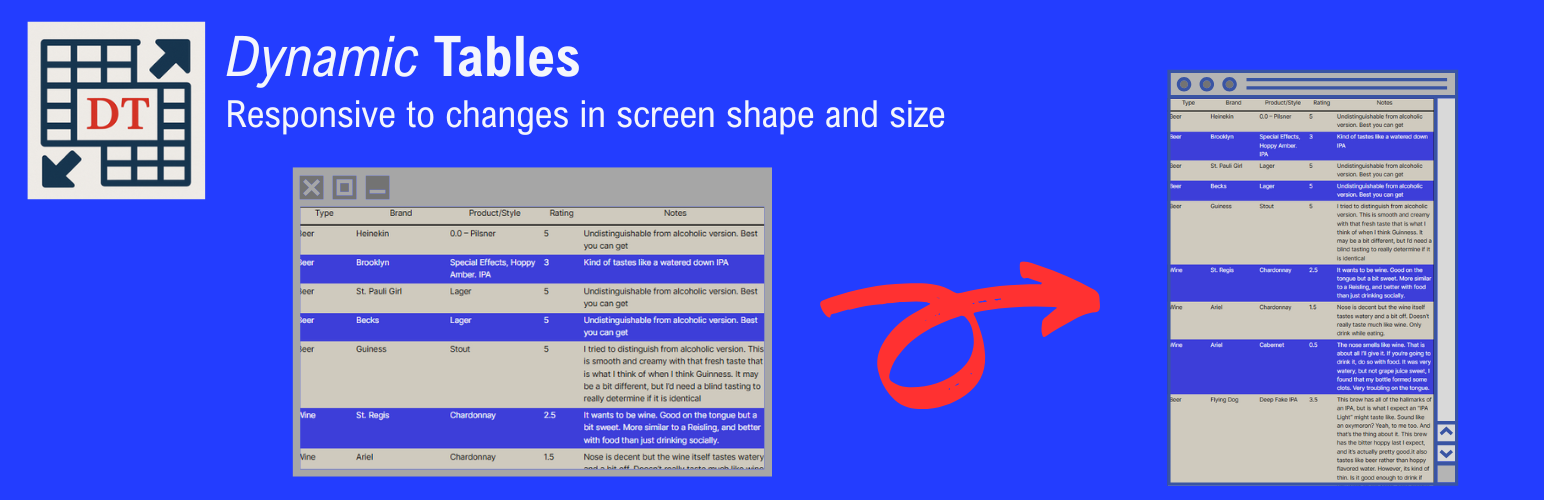
- Fully responsive: tables scale, wrap and adapt to mobile screens
- Clean semantic HTML output for SEO and accessibility
- Lightweight footprint and compatible with modern themes
- Table export for backup purposes
Why Choose Dynamic Tables over other table block?
Dynamic Tables is designed specifically for tables that require ongoing updates, consistent structure, and reliable responsive behavior. It is an ideal option if your use case goes beyond basic layout tables and into repeatable, data-oriented content. Dynamic Tables provides a purpose-built solution that stays fully native to the block editor.
Roadmap
Some roadmap highlights include:
- Integrating Dynamic Tables with WordPress search
- Adding more content types and formats for all rows in a column (e.g, images, links, buttons, numeric formats, etc.) without the need to format each cell
- Support for front end interactivity to sort and filter tables
- Importing in common formats (e.g., csv, xlsx)
- Enhanced responsive formatting for mobile devices
- Front end editing
For WordPress Developers
Dynamic Blocks has an architecture that is somewhat unique to the world of Gutenberg development in that the table definition and content are stored in custom WordPress database tables because we didn’t believe it structurally lent itself well to the Post data metaphore. These are the primary building blocks:
- Table data and definitions are abstracted through block entity types
- Entities natively call RESTful api’s
- An underlying WordPress REST API service supports the loading and saving of table data
- The service interacts with a highly abstracted SQL layer which leverages WordPress WPDB
- The tables themselves leverage the newer CSS grid framework
- Much of the flexibility is derived from grid functinality that has been incorporated into mainstream web browsers in the past few years
- This framework provides responsiveness that doesn’t “break” table structure. Misalighed rows and columns, unexpected wrapping, and otherwise indecipherable tables have been beaten down.
- The API architecture will eventually support data stored in external files or web services. We’re considering these capabilities in our roadmap.
Installation
- In your WordPress dashboard, go to Plugins Add New, search for Dynamic Tables, click Install Now and then Activate.
- Alternatively: Download the ZIP file from the WordPress Plugin Directory. Upload it via Plugins Add New Upload Plugin, install and activate.
- After activation, open any post or page, click the + button in the block editor and insert the “Dynamic Table” block.
- Start building your table: add columns and rows, set header options, adjust widths, edit content, enable sorting.
> Note: On multisite installations the plugin must be activated on each site where it is used (network-activation is not supported).
> Important: Deactivating and deleting the plugin does not auto-remove stored tables. However, there is an setting to support the removal of stored tables. Re-activating restores existing tables in posts.
Screenshots

Create a new Dynamic Table block

Format specific table text

Insert columns and rows

Format header row if one exists

Format header grid lines

Format table body

Set column width (corresponding configuration is available for rows too)
Faq
Not yet in this version. The architecture for external data sources is in the roadmap, and upcoming versions will include more import/export options.
Yes. Dynamic Tables outputs semantic HTML and relies on standard CSS. It should be compatible with virtually all well-coded themes.
Yes. The responsive behavior ensures tables resize, wrap or scroll appropriately to maintain readability on smaller screens.
No. This plugin is free to use. However, we are planning for a premium version of Dynamic Tables to support advanced features.
- Dynamic Tables block will render while the pluggin is disabled or deleted.
- Data may be retained or deleted when the plugin is uninstalled. The default is to retain the data.
- Reinstallation and activation will make all tables reappear if the data has not been purged.
Reviews
Changelog
1.2.1
- Fixed bug that made a date/time render in date/time columns when there was not underlying value
1.2.0
- Separated table control activity from editing so that navigation, delete key, etc. will work properly when not otherwise editing a cell
- Added a Date/Time content type
- Added ability to update column names
- Added a column menu to select content types and related actions
- Added framework for column driven content types
- Refactor Column menus to enhance stability and performance
- Refactor Row menus to enhance stability and performance
1.1.1
- Add keyboard navigation through table cells via arrow keys
- Added a visual indicator to easily identify what cell you’re currently editing
- Refactor editor to break out Cell as its own component in support of future enhancements
- Support for table exports that can be used for backup and recovery
1.1.0
- Fix bug that caused fatal error when editing post with “Show Template” enabled
- Support for post templates and patterns.
- Created scheduled maintenance to ensure posts and tables are internally consistent
- Automatically remove tables when their underying posts are deleted from the admin page
- Provide visibility to all tables, their status, associated post, and to view the table data
- Bump support for WordPress 6.9
1.0.0
- Initial Release