Fuldash

Fuldash
Description
Fuldash connects your WooCommerce store to the Fuldash platform, which automates order
fulfillment. It creates a QuickBooks Online invoice and records the payment. It
generates a shipping label with your connected carrier, choosing box and rate
automatically. Product, payment, and expense mapping are configured from your Fuldash
dashboard, where all order tracking and fulfillment status live — this plugin’s only
job is getting order data there and marking orders complete once fulfillment finishes.
How it works:
- A customer places an order in your WooCommerce store.
- When the order is created, the plugin forwards the order to your Fuldash platform.
- Fuldash creates a QuickBooks invoice, records the payment, and generates a shipping
label — choosing carrier, box, and rate automatically — all in the background. - Once fulfillment finishes, Fuldash marks the order Completed in your store
automatically — no manual updates needed.
Setup takes under two minutes:
- Install and activate this plugin.
- Go to WooCommerce Settings Fuldash.
- Paste your API Key from your Fuldash merchant dashboard (Settings Profile).
- Click Save changes, then click Activate to connect your store to the platform.
Channel control:
Use the Activate / Deactivate button on the settings page to connect or disconnect your
store from Fuldash at any time. Deactivating stops order forwarding without removing
your credentials — you can reactivate instantly when ready.
External Services
This plugin sends data to the Fuldash platform (https://fuldash.com), an external
third-party service.
What is sent and when:
- Channel activation / deactivation — when you click Activate or Deactivate, a
request is sent to the Fuldash platform to record your store’s connection status. - Order data — when an order is created and the channel is active, the full
WooCommerce order (line items, addresses, payment method, totals) is sent to the
Fuldash platform for fulfillment processing.
What Fuldash can request from your store:
Fuldash’s fulfillment platform also makes authenticated requests back to your store,
used to help you configure product, payment, and expense mappings in your Fuldash
dashboard, and to keep your order statuses in sync:
- Product catalog — product names and SKUs, so you can map them to your accounting
items in the Fuldash dashboard. - Payment gateways — the ID, title, and enabled status of your configured WooCommerce
payment gateways, so you can map them to accounting payment methods. - Recent order fee data — numeric and JSON order meta fields on your 25 most recent
orders, used to detect payment-processor fee fields (e.g. Stripe or PayPal fees) for
expense tracking. No customer personal data is included in this scan. - Order completion — once fulfillment finishes, Fuldash marks the corresponding
order Completed in your store.
Every request in both directions is authenticated with your per-store API Key.
Service information:
- Service URL: https://fuldash.com
- Terms of Service: https://fuldash.com/terms
- Privacy Policy: https://fuldash.com/privacy
Installation
- Upload the
fuldashfolder to/wp-content/plugins/. - Activate the plugin via the Plugins menu in WordPress Admin.
- Go to WooCommerce Settings Fuldash and enter your credentials.
- Click Activate to connect your store to the Fuldash platform.
Screenshots
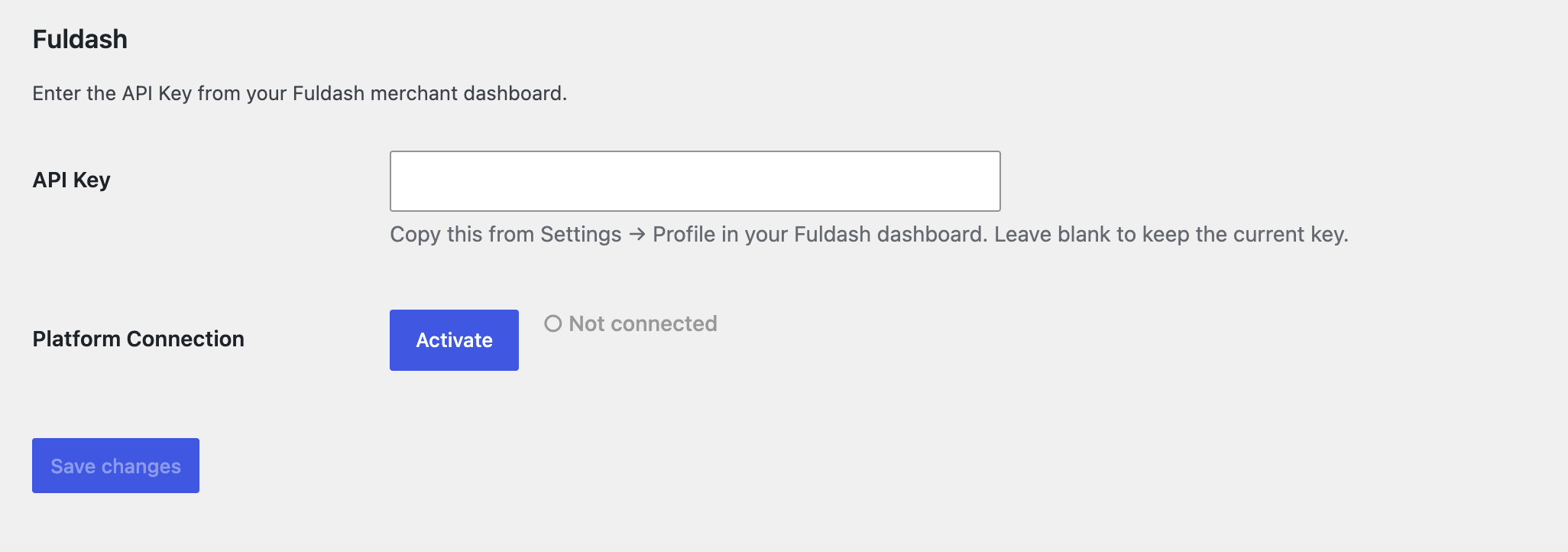
The Fuldash settings tab under WooCommerce → Settings, showing the API Key field and Activate / Deactivate button with connection status.
Faq
Log in to your Fuldash merchant dashboard and open Settings Profile.
Your API Key is displayed there with a one-click copy button.
The plugin sends the complete WooCommerce order object, including line items,
billing and shipping addresses, payment method, and order totals.
Clicking Activate with a key that doesn’t match your Fuldash dashboard shows “API
key not recognized” — enter the correct key in Settings and save before trying again.
If the platform can’t be reached, it shows “Server unreachable — try again later”; your
key is unaffected, so just click Activate again once the platform is back.
The order is still created normally in WooCommerce. The failure is logged to
WooCommerce Status Logs (source: fuldash), and the order’s forwarding status is
visible in your Fuldash dashboard.
Yes. Click Deactivate on the settings page. Your API Key remains saved.
Click Activate at any time to resume forwarding.
The plugin stores your API Key and connection status in your WordPress
database (wp_options). It also stores a forward status flag on each order as order
meta. No order data is stored by the plugin itself — it is forwarded to Fuldash and
not retained locally. Uninstalling the plugin removes the saved API Key and connection
status from your database.
Yes. Once Fuldash finishes creating the QuickBooks invoice and generating the shipping
label, it calls back to your store to mark the order Completed — you don’t need to
update order status by hand.
Reviews
Changelog
1.1.0
- Order line items and the product catalog endpoint now include weight and dimension
data, used for shipping label generation on the Fuldash platform. - API keys are now validated when you click Activate instead of when you save them.
- Removed the per-order forwarding status column from the WooCommerce orders list —
fulfillment status is tracked in your Fuldash dashboard.
1.0.0
- Initial release.