Gregius Optimizer
Gregius Optimizer
Description
Gregius Optimizer gives content editors and site administrators a unified control panel for search, social, and AI metadata — without leaving the block editor.
Panels
- Sitemap — Toggle post types, taxonomies, and authors in your XML sitemap. Exclude individual posts from search engines with a single click.
- Robots.txt — Edit your robots.txt file from a modal textarea with dynamic row sizing. Reset to WordPress defaults at any time.
- Schema — Full schema.org type map with 174 subtypes across 9 categories (Article, WebPage, CreativeWork, Event, Organization, Person, Place, Product, Review). Assign global defaults per post type, override per post, and preview JSON-LD with clipboard copy. Organization JSON-LD includes sameAs and logo.
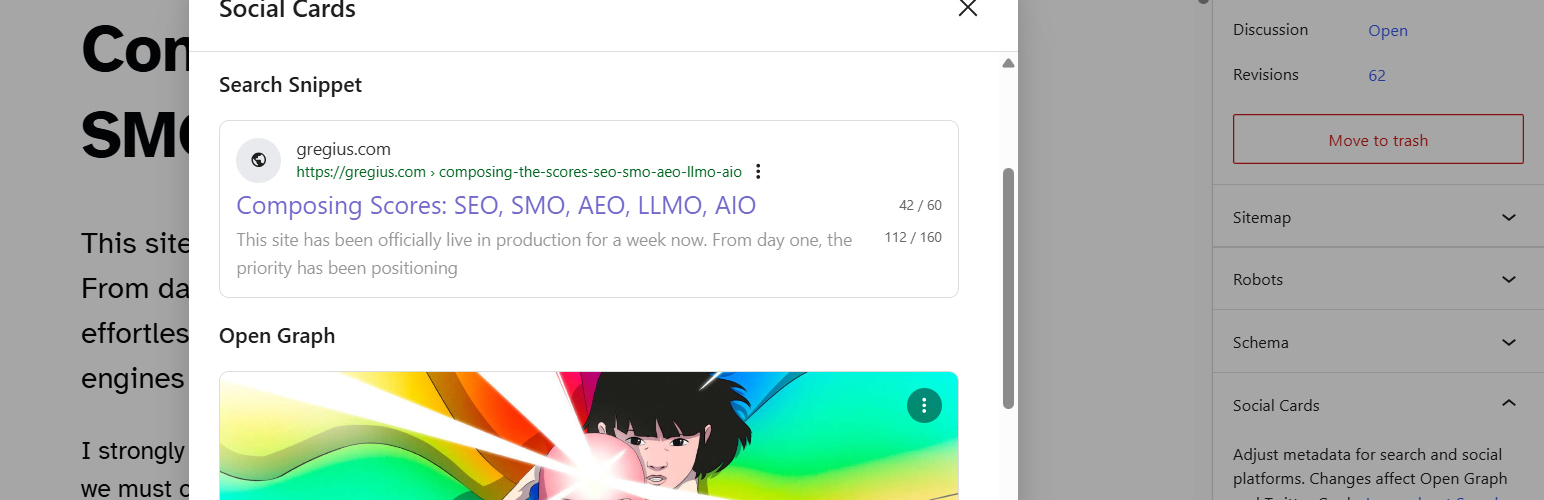
- Social Cards — Per-platform title, description, and image overrides for Google Search Snippets, Open Graph (Facebook, LinkedIn), and Twitter/X Cards. Inline live previews with character counters (Google 60/160, OG 55/65, Twitter 70/200). Global fallback image with kebab menu.
- LLMs — Auto-generate
/llms.txtfrom site content for AI agent discoverability. Custom context editing with live preview. Per-post include toggle with custom descriptions.
All panels are accessible from PluginDocumentSettingPanel in the Gutenberg sidebar, listed in order: Sitemap Robots Schema Social Cards LLMs.
Key Features
- Meta description and canonical URL output via
wp_head pre_get_document_titlefilter for Google-specific title override- Open Graph (
og:*) and Twitter Card meta tags with per-platform fallback chains gg_optimizer_ogimage size (1200×630, cropped) registered onafter_setup_theme- JSON-LD structured data: Organization (configurable subtype), WebSite, BreadcrumbList, article/page (174 subtypes)
@graphwrapper for multiple JSON-LD nodes- Custom DB table (
gg_optimizer_settings) shared across all features - REST endpoints for all settings: sitemap, robots, schema, social cards preview, llms override and preview
- Filter-based architecture — every output group can be disabled via filters
- All meta fields support revisions
Contributors & Developers
Gregius Optimizer is open source software. The following people have contributed to this plugin.
- Hector Jarquin — Lead developer and maintainer
- Gregius — Product owner and sponsor
Visit the contributor profiles on WordPress.org:
* https://profiles.wordpress.org/hectorjarquin/
* https://profiles.wordpress.org/gregiusteam/
Repository
Source code and build instructions:
https://github.com/gregius/gregius-optimizer
This plugin uses npm and @wordpress/scripts for asset compilation. Source JavaScript lives in assets/src/ and compiles to assets/build/. All PHP source is human-readable.
External Services
Gregius Optimizer does not send data to any external service. The following URLs are referenced as documentation or standards only:
- Google Robots — https://developers.google.com/search/docs/crawling-indexing/robots/intro — robots.txt and meta robots documentation
- Schema.org — https://schema.org/ — structured data vocabulary reference
- Google Structured Data Gallery — https://developers.google.com/search/docs/appearance/structured-data/search-gallery — structured data feature reference
- Open Graph Protocol — https://ogp.me/ — Open Graph meta tag specification
- Twitter/X Cards — https://docs.x.com/overview — Twitter Card meta tag documentation
- llms.txt — https://llmstxt.org/ — llms.txt proposal specification
Installation
- Upload the
gregius-optimizerfolder to/wp-content/plugins/ - Activate through the Plugins screen in WordPress
- Open any post or page in the block editor — the optimizer panels appear in the right sidebar
Screenshots

Sitemap settings via the editor

Robots settings via the editor

Schema settings via the editor

Social cards settings via the editor

LLMs settings via the editor
Faq
Gregius Optimizer focuses on the Gutenberg-native editing experience for metadata that those plugins often bury in separate metaboxes. It can complement or replace them depending on your workflow.
All public post types that support custom-fields. Meta fields, schema subtype, and LLMs toggle register on every public post type automatically.
Yes. Each output group (meta description, canonical, Open Graph, Twitter Cards, Schema, LLMs, Sitemap, Robots) can be toggled on/off from their respective settings modal in the block editor. Each modal has an on/off switch at the top.
Yes. Settings for sitemap, robots.txt, schema defaults, and LLMs context are stored in {$prefix}gg_optimizer_settings. The table is created on activation and removed on uninstall.
The text domain is gregius-optimizer. A .pot file is not bundled; translations are handled via the standard WordPress translation system.
Reviews
Changelog
1.2.1
- Fixed: llms.txt blockquotes and markdown corrupted by HTML entity escaping
- Improved: documentation restructured as OKF v0.1 knowledge base
1.2.0
- Added: Sitemap URL selector — toggle which URLs serve your sitemap
- Fixed: Saving one feature toggle no longer disables other features
- Fixed: Per-post meta UI now renders on all public post types
- Fixed: Stale Sitemap lines in robots.txt now replaced with current settings
- Improved: robots.txt and llms.txt Sitemap lines dynamically reflect active URLs
1.1.1
- Fixed: Schema validation warnings for primaryImageOfPage and breadcrumb on BlogPosting
- Improved: JSON-LD structure now uses proper WebPage wrapper + content entity pair
1.1.0
- Feature toggles — enable/disable each feature from its settings modal
- Added: robots.txt support for multisite subsites
- Fixed: partial toggle saves no longer reset other features
- Fixed: Google snippet title now properly feeds the tag
- Moved: “Hide from search” from Sitemap to Robots modal
- Improved: Google search snippet fields used as fallbacks for meta tags
- Improved: HTML output comments now contextual, per-section
- Security: input sanitization and escaping throughout
1.0.0
- Initial release
- Sitemap panel with per-post-type/taxonomy/author toggles and noindex per-post
- Robots.txt modal editor with reset to defaults
- Schema panel with 174 subtypes across 9 categories, Organization type, per-post override, JSON-LD preview
- Social Cards panel with Google Search Snippet, Open Graph, Twitter/X Cards, Global Image, character counters
- LLMs panel with auto-generated llms.txt, custom context, per-post include toggle, live preview
- Meta description and canonical URL output
- Open Graph and Twitter Card meta tags with per-platform fallback chains
- JSON-LD structured data: Organization, WebSite, BreadcrumbList, article/page
- 11 custom meta fields with revision support
- REST API endpoints for all settings and previews