imagIn – WebP & AVIF Converter

imagIn – WebP & AVIF Converter
Description
imagIn – WebP & AVIF Converter helps you convert JPG, JPEG, and PNG images to modern WebP or AVIF formats from inside WordPress.
The plugin runs on your own server using available PHP image libraries. It does not send image files to an external service, require a cloud account, or lock conversion features behind a premium plan.
Key features
- Convert JPG, JPEG, and PNG files during upload.
- Convert existing JPG, JPEG, and PNG media files one at a time from the Media Library.
- Bulk convert existing JPG and PNG media files in small batches from the imagIn settings page or directly from the Media Library.
- Choose the output format: WebP or AVIF.
- Keep the original file, replace it after conversion, or move it to a backup folder.
- Set separate quality levels for WebP and AVIF.
- Check available PHP memory before converting large images and show an actionable message when more memory is needed.
- Check server support for GD, Imagick, WebP, and AVIF.
- Store conversion metadata on each attachment.
- Show conversion status in the Media Library.
- Show progress and a clear completion result during bulk conversion.
- Update image URLs in page content and builder data after conversion, including Elementor data.
- Use local server libraries only.
Local-first image conversion
imagIn is designed for site owners who want a simple conversion workflow without connecting WordPress to an external optimization platform. Conversion support depends on the image libraries available on your hosting server.
If your server does not support WebP or AVIF through GD or Imagick, the plugin will show the capability status and skip unsupported conversions safely.
Original file handling
You can choose how imagIn handles original images after a successful conversion:
- Keep the original file and its WordPress image metadata. The converted file is stored in uploads without creating a second Media Library attachment.
- Replace the original file with the converted file. The converted file becomes the main Media Library asset used by pages and templates that reference that attachment.
- Move the original file and generated source sizes to a backup folder inside uploads.
If existing pages depend on a direct JPG or PNG file URL, keep Update page image references enabled before using any handling mode. Matching URLs in WordPress content and builder metadata will be updated after a successful conversion. Keep original remains the safest choice for the original attachment and its metadata, but URLs stored outside WordPress content or metadata still cannot be identified automatically.
When Update page image references is enabled, imagIn also updates matching image URLs in post content, excerpts, and post metadata used by page builders. This helps Elementor and other builders switch to the converted file without replacing each image manually.
Privacy
imagIn processes images locally on your WordPress server.
The plugin does not send image files, site data, or usage data to an external API, CDN, cloud service, or third-party optimization platform.
Support
imagIn is completely free and does not include premium features, usage limits, or cloud requirements.
If this plugin helps your workflow, you can support future development through Trakteer:
https://trakteer.id/inkamediautama
Installation
- Upload the
imagin-webp-avif-converterfolder to the/wp-content/plugins/directory, or install the plugin through the WordPress Plugins screen. - Activate the plugin through the
Pluginsscreen in WordPress. - Go to
Media > imagIn – WebP & AVIF Converter. - Choose WebP or AVIF as the output format.
- Choose how original files should be handled after conversion.
- Keep
Update page image referencesenabled if converted images should replace matching JPG/PNG URLs in pages and builder data. - Set the image quality values.
- Upload a JPG, JPEG, or PNG image to test automatic conversion.
Screenshots
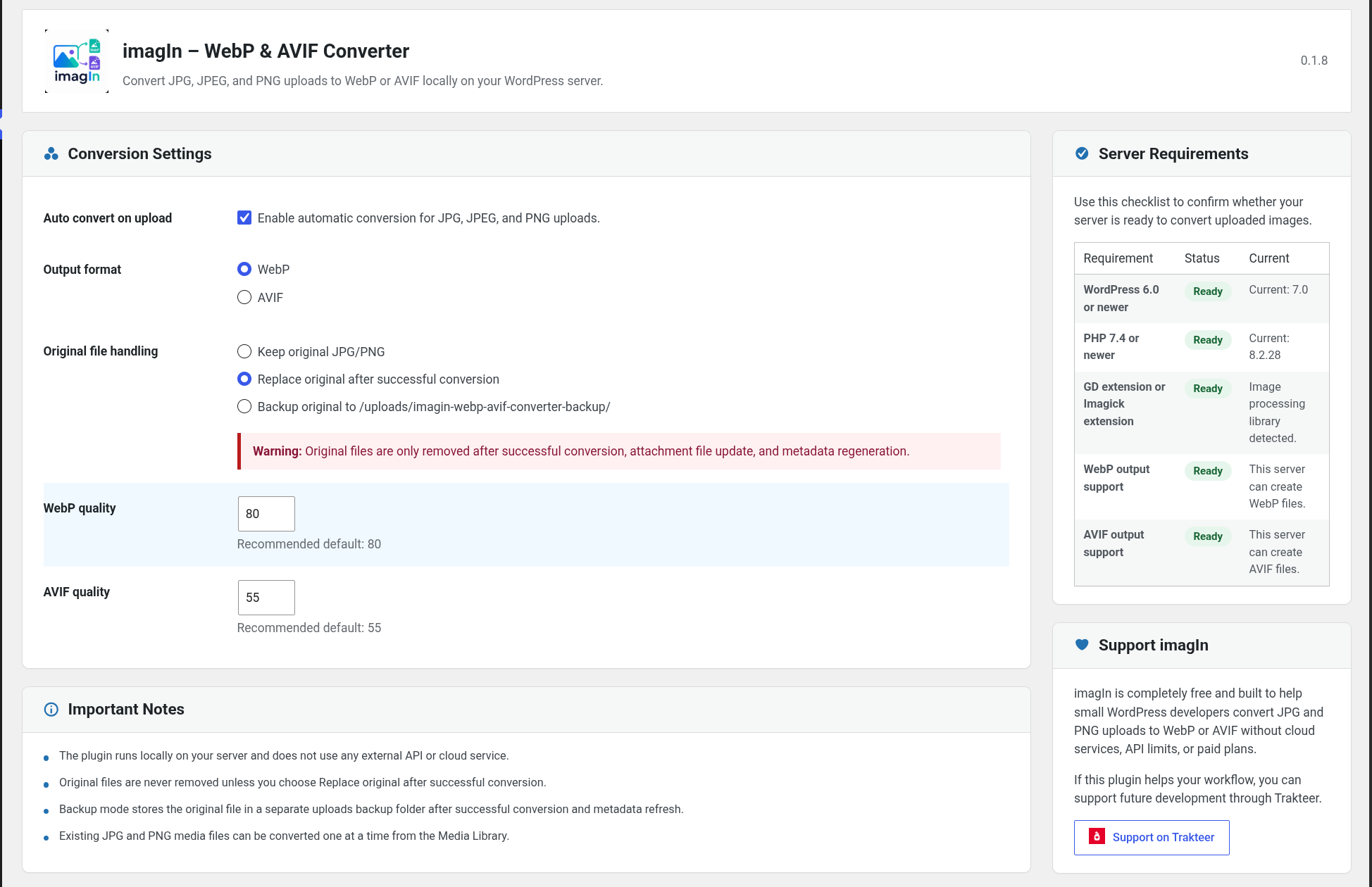
imagIn settings page with automatic upload conversion, output format selection, original file handling, quality controls, server requirements, and support information.
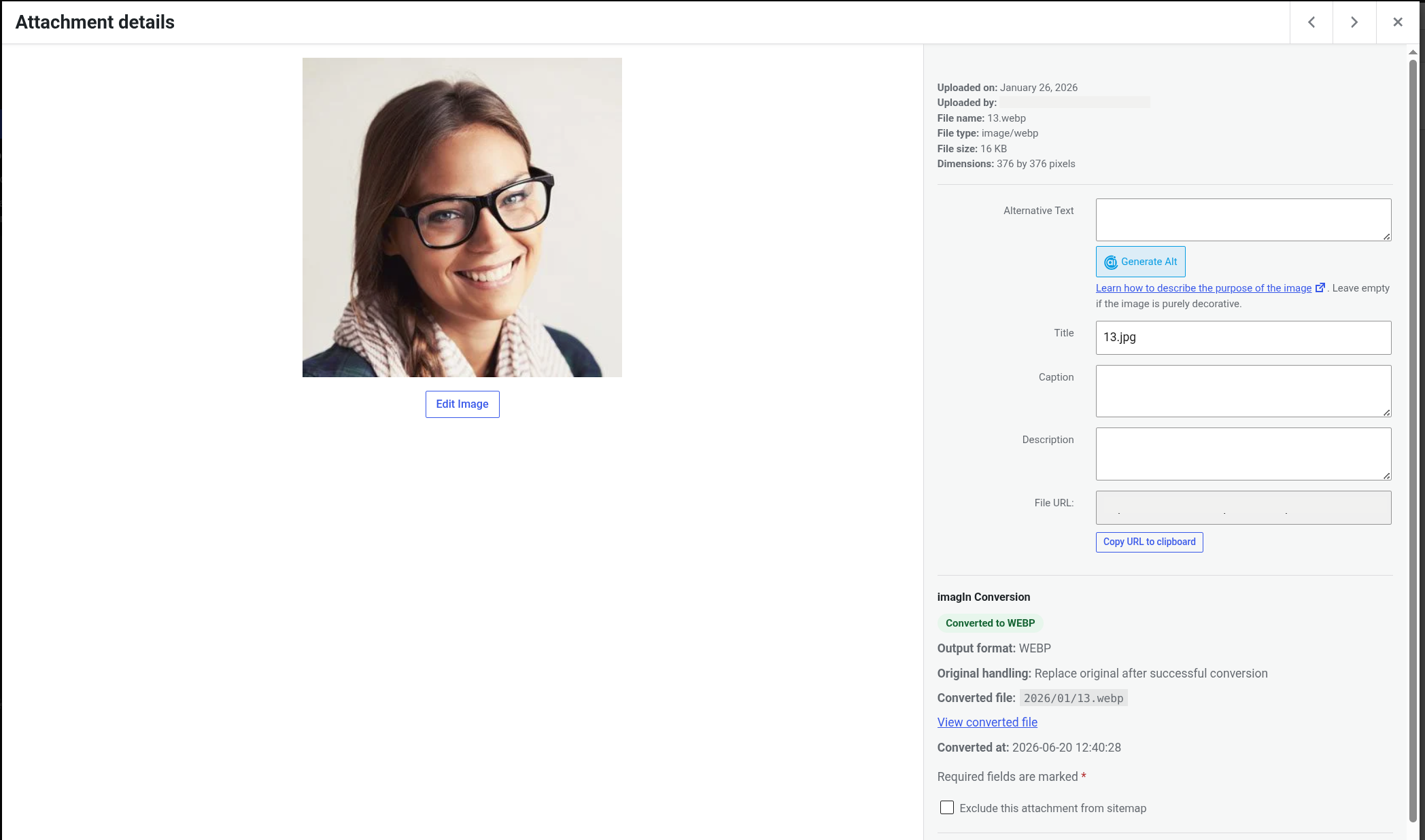
Attachment details panel showing a converted WebP image, conversion metadata, output format, original handling mode, converted file path, and converted timestamp.
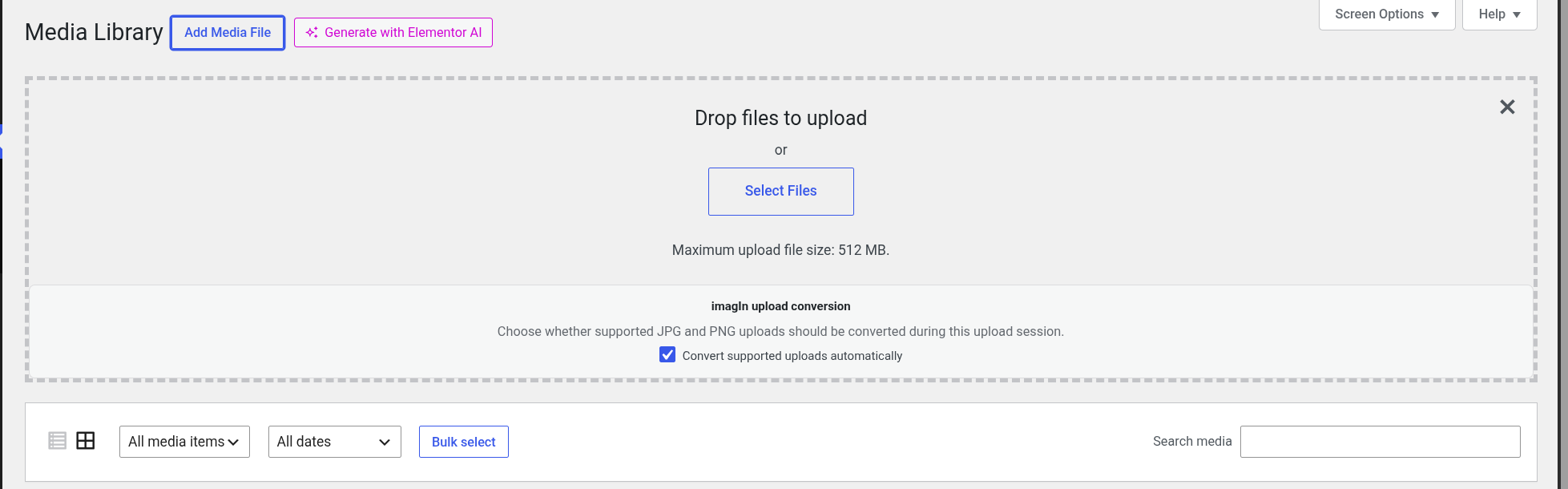
Media Library upload screen with the imagIn upload conversion option for automatically converting supported JPG and PNG files during the current upload session.
Faq
No. All conversion happens locally on your WordPress server.
No. The plugin does not send image files, site data, or usage data to an external API or cloud service.
JPG, JPEG, and PNG images can be converted during upload. Existing JPG, JPEG, and PNG media files can be converted individually, selected in the Media Library for bulk conversion, or processed in batches from the imagIn settings page.
The plugin supports WebP and AVIF when your server image library supports those formats.
WebP and AVIF support depends on the GD or Imagick configuration installed on your hosting server. If a format is unavailable, contact your hosting provider and ask whether the required image library support can be enabled.
Large images need much more server memory after they are opened for processing than their uploaded file size suggests. imagIn checks the image dimensions before conversion on GD-based servers and explains when the available PHP memory is not enough. Try a smaller image, increase the PHP memory limit, or ask your hosting provider to enable Imagick.
Only if you choose Replace original after successful conversion. You can also keep the original file or move it to a backup folder.
Yes. Convert one image from its attachment details, select multiple JPG/PNG items and choose Convert selected, or use the bulk conversion control on the imagIn settings page.
Yes. Bulk conversion runs in small batches and shows its progress. When the process finishes, imagIn reports how many images were converted successfully and how many need attention. Page and builder reference updates run in short follow-up requests so the conversion screen does not wait on a long database operation.
Yes. When Update page image references is enabled, imagIn updates matching JPG, JPEG, and PNG URLs in page content and post metadata after a successful conversion. This covers common Elementor data and other builders that store image URLs in WordPress content or metadata. In Keep mode, URL-based references can use the converted file while the original attachment ID and its WordPress metadata remain unchanged; Replace and Backup modes update the attachment metadata to the converted asset.
No. The plugin does not use shell command execution.
Reviews
Changelog
0.1.17
- Improved bulk conversion progress and reliability, especially for larger image collections and slower hosting servers.
- Updated page and builder image references in manageable follow-up steps so long conversions are less likely to time out.
- Added automatic retries and resume support for temporary server or network interruptions during bulk conversion.
- Added clearer status messages when an image reference needs attention after conversion.
- Improved the Media Library bulk selection button so selected images and conversion progress are easier to follow.
- Made Keep mode preserve the original Media Library attachment and its WordPress image metadata without creating an extra attachment.
- Kept conversion errors visible until the next user action so problems are easier to review.
0.1.16
- Added automatic image URL normalization for page content, excerpts, and page-builder metadata after successful conversion.
- Improved compatibility with Elementor and other builders that store image URLs in post metadata, including serialized and JSON data.
- Added an admin setting to enable or disable automatic page image reference updates.
0.1.15
- Added bulk conversion for existing JPG and PNG images from the settings page and the Media Library bulk toolbar.
- Added batch processing, visible progress, and clear completion feedback for bulk conversions.
- Improved conversion status reporting so a valid converted image is not shown as failed when original-file cleanup needs attention.
- Improved Replace and Backup handling for original files and WordPress-generated image sizes.
- Improved file-path validation, processing protection, and compatibility with local hosting file systems.
- Cleaned plugin-owned conversion metadata, generated attachments, and backup files during uninstall.
0.1.14
- Fixed automatic Replace original conversion so cleanup runs after WordPress creates the original image sizes.
0.1.13
- Fixed the upload conversion confirmation so it is shown only once on Media Library upload screens.
- Fixed Replace original mode so it removes WordPress full-size originals and generated JPG/PNG sizes after a successful conversion.
0.1.12
- Added a memory preflight check for large images on GD-based servers.
- Raised the WordPress image memory limit when the server configuration allows it.
- Improved conversion failure messages and optional debug details for image processing errors.
0.1.11
- Improved the settings page header so admin notices stay in a cleaner position.
0.1.10
- Added the required license file for WordPress.org distribution.
- Improved original-file backup handling for better compatibility with WordPress hosting environments.
- Improved translation readiness for WordPress.org language packs.
- Improved plugin information and file structure for the WordPress.org directory.
0.1.9
- Simplified the Attachment Details conversion panel.
0.1.8
- Improved manual conversion panel placement in Attachment Details.
- Added button progress feedback during manual conversion.
- Refreshed the Media Library view after successful manual conversion.
- Added upload conversion controls in editor media modals.
0.1.7
- Added manual conversion controls in Attachment Details.
- Improved admin page asset loading.
- Updated plugin information for WordPress.org submission.
0.1.6
- Refined the settings page header and card alignment.
0.1.5
- Updated the settings page product header layout.
- Updated the support button icon.
0.1.4
- Kept manual conversion available from the Media Library list and Attachment Details views.
- Added converted files to the Media Library when Keep original is selected.
- Improved loading of imagIn conversion details in media modals.
0.1.3
- Moved imagIn conversion details into a clearer Media modal panel.
- Fixed duplicate upload conversion options in the Media Library upload area.
- Improved Media modal updates after manual conversion.
0.1.2
- Improved the replace-original option so converted files become the main attachment file correctly.
- Improved Media modal alignment for imagIn conversion details.
0.1.1
- Refined the settings page layout.
- Added a Trakteer icon to the support button.
0.1.0
- Initial release.
- Convert JPG, JPEG, and PNG uploads to WebP or AVIF.
- Added original file handling modes: keep, replace, and backup.
- Added quality settings for WebP and AVIF.
- Added Media Library conversion status column.
- Added local server capability checks.