Wonderful Repeated Hit Blocker for Wordfence

Wonderful Repeated Hit Blocker for Wordfence
Description
Wordfence records every request its firewall classifies as an attack. A single
attack rarely justifies a block — but the same address showing up again and
again within a few minutes almost always does.
Wonderful Repeated Hit Blocker watches that attack log and blocks the repeat
offenders for you. You decide how many logged attacks within how many minutes
are enough, and how long the resulting block lasts.
How the blocks are created
Blocks are created through Wordfence’s own public blocking API
(wfBlock::createIP()), not by writing into its database tables. That matters:
- Wordfence’s allowlist is always honoured — allowlisted addresses are never blocked.
- The block shows up in the normal Wordfence Blocking screen and can be removed there.
- The Wordfence firewall is synchronised the same way it is for a manual block.
- Wordfence’s own block counters stay correct.
- Schema changes in future Wordfence releases cannot corrupt your block table.
Safety rails
- Only requests Wordfence flagged as attacks are counted. Ordinary traffic — visitors, crawlers, your own browsing — is never part of the calculation.
- Your own IP address is added to the plugin’s allowlist when you activate it, and the settings screen tells you if it is not covered.
- Wordfence’s allowlist is respected in addition to the plugin’s own list.
- Addresses that already carry an active Wordfence block are skipped, so blocks are never silently extended and alerts are never repeated.
- Without Wordfence the plugin does nothing at all and says so with an admin notice.
Optional alerts
Set a webhook URL (Slack, Discord, Mattermost, or your own endpoint) and you
get a message for every new block. Leave the field empty and the plugin makes
no outbound connections whatsoever.
External services
This plugin contacts no external service by default.
If — and only if — you enter a webhook URL on the settings screen, the plugin
sends one HTTP POST request to exactly that URL each time it creates a new
block. The endpoint is chosen by you; this plugin is not affiliated with any
particular provider.
Data transmitted with each request:
- the URL of your site,
- the IP address that was blocked,
- the number of attacks Wordfence logged for it,
- the length of the time window in minutes.
Nothing else leaves your server. No data is transmitted while the webhook field
is empty, and the plugin never contacts wonderfulplugins.eu or any other
service of ours.
If you use a hosted service such as Slack or Discord as the endpoint, their
terms and privacy policies apply to the data you forward to them — for example
Slack (https://slack.com/terms-of-service, https://slack.com/trust/privacy/privacy-policy)
or Discord (https://discord.com/terms, https://discord.com/privacy).
Installation
- Install and activate Wordfence Security. This plugin has no effect without it.
- Install and activate Wonderful Repeated Hit Blocker.
- Go to Settings Repeated Hit Blocker.
- Check that your own IP address appears in the allowlist. The plugin adds it on activation; if you administer the site from several networks, add those addresses too.
- Adjust the time window, the hit threshold and the block duration to taste. The defaults block an address for 30 days after 5 logged attacks within 10 minutes.
- Optionally add a webhook URL to be notified about new blocks.
Screenshots
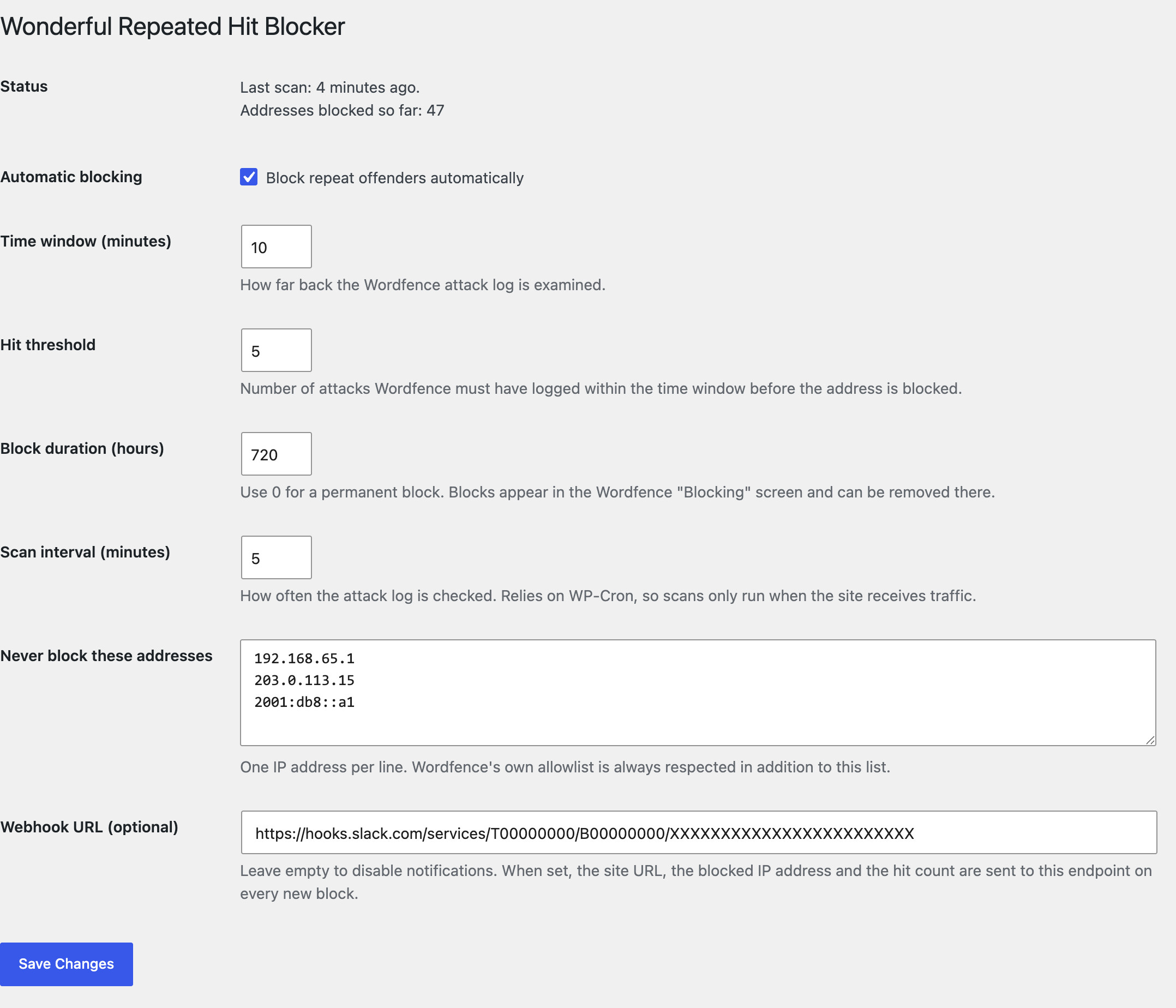
The settings screen with the time window, hit threshold, block duration and allowlist.
Faq
Yes. The plugin reads Wordfence’s attack log and uses Wordfence’s blocking API.
Without an active Wordfence installation it stays completely inactive and shows
an admin notice.
The plugin is built so that you cannot do so by accident. Your IP address is
added to the allowlist when you activate the plugin, Wordfence’s own allowlist
is respected as well, and only addresses that Wordfence has already flagged as
attackers are ever considered. Should you still end up blocked, remove the
block in the Wordfence Blocking screen — every block created here is a
normal Wordfence IP block.
No. Only requests that Wordfence’s firewall has recorded as an attack are
counted. A visitor who mistypes a password does not appear in that log.
The block reason in Wordfence starts with “Repeated Hit Blocker” and states how
many attacks were logged in which time window.
Yes. Wordfence keeps a single, network-wide attack log and block list, and the
plugin uses Wordfence’s own table resolution, so it works the same way.
Every 5 minutes by default, configurable between 1 and 60 minutes. Scanning
runs on WP-Cron, which only fires when your site receives traffic — on a very
quiet site scans may happen less often than configured.
Not unless you configure a webhook URL yourself. See the “External services”
section above.
Reviews
Changelog
1.0.0
- Initial release.